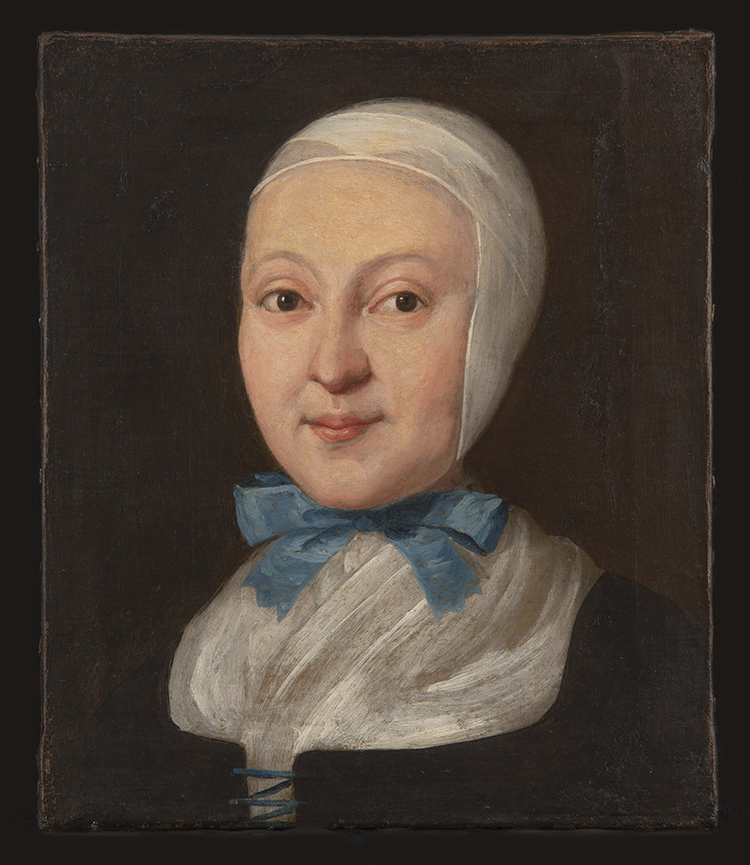
Anna Maria Benzien
Anna Maria Benzien was the daughter of Jacon Neisser and Anna Holaschk who were among the founders of Herrnhut. In 1744, Anna Maria maried Christian Thomas Benzien (1715-1757) (acc. 399.1) and in 1754 they immigrated to Bethlehem, Pennsylvania from Germany. The artist, John Valentine Haidt, was among their fellow passegers. Although Anna Maria never traveled to North Carolina, her husband was one of Count von Zinzendorf’s trusted advisors who came to North Carolina on a political mission in 1755. He was instrumental in negotiating the establishment of Wachovia as an Episcopal Parish, which allowed the Moravians certain rights and privileges in the Anglican colony. After her first husband’s death in 1787, Anna Maria married another Moravian minister, Amadeus P. Thrane.
The Benziens had two children who came permanently to Salem. Their daugher, Anna Benigna Benzien (1751-1818), arrived in 1790 and led an active life as a member of the Single Sisters Choir and as a teacher in the Salem Girls Boarding School. Their son, Christian Lewis Benzien (1753-1811), came in 1781 as a teacher, served as an assitant to Frederick William Marshall, and became a prominent spiritual and political leader in Salem.
ARTIST: John Valentine Haidt (1700-1780) was a Moravian artist and evangelist, born in Danzig, Germany on October 4, 1700. As the son of a goldsmith, John Valentine learned that trade initially from his father, Andreas Haidt, a goldsmith for Emperor Frederick I. He later attended the Royal Academy in Berlin before traveling and studying painting in Venice, Rome, Paris, and London. When he was forty years of age he joined the Moravian church. In 1754 he immigrated to America, was ordained a minister of the church, and began to preach in Pennsylvania even as he continued to paint. Although Haidt painted portraits and is known to have painted landscapes, his religious paintings are among the earliest of that genre created in the American colonies. Recent research suggests that Haidt taught American born painter, Benjamin West (1738-1820) when he was preaching in Philadelphia in 1754-55. West told a friend that a “Mr. Hide (Haidt), a German, gave him instruction.”
Haidt died in Bethlehem, Pennsylvania, January, 18, 1780. In his memoir he wrote, “I hardly need to mention that I have painted, because almost all of the congregations have some of my work, which the dear Savior also let be a blessing to many a heart.”
CONSERVATION: The painting was conserved in 2014 by the Colonial Williamsburg Foundation.
Haidt died in Bethlehem, Pennsylvania, January, 18, 1780. In his memoir he wrote, “I hardly need to mention that I have painted, because almost all of the congregations have some of my work, which the dear Savior also let be a blessing to many a heart.”