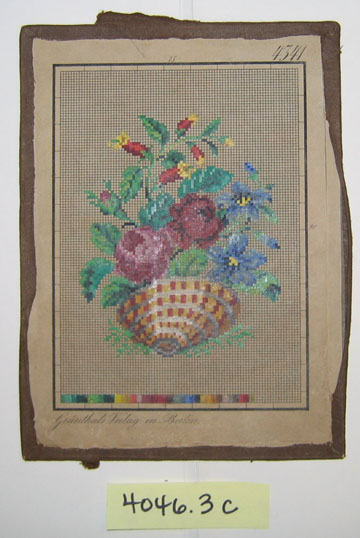
Berlin work pattern
BERLIN WORK: “In Philadelphia animals and birds are almost the only designs used for working in worsteds, while with us it is impossible to sell anything but flower pieces. J. J. Whitney of Boston to Inspector Jacobson April 11, 1836.”
Berlin work developed in Germany in the early 19th century. Printed patterns for brightly colored wools, or “worsteds”, were widely distributed and commercially available by the 1820’s. Patterns were printed on “point”, or graph, paper with colored blocks corresponding to squares on the canvas. The stitcher had only to follow the graph and count lines, squares, and stitches to create colorful elaborate designs. The most popular patterns included wreaths, bouquets of flowers, animals, patterns for shoes, and pictorials.
By the 1840’s, the rage for Berlin work had replaced the preference for elaborate silk on silk techniques that had been popular in Salem Girls’ Boarding School suggesting that teachers and students alike embraced this popular needlework technique to create a variety of personal accessories, household objects, and pictures.