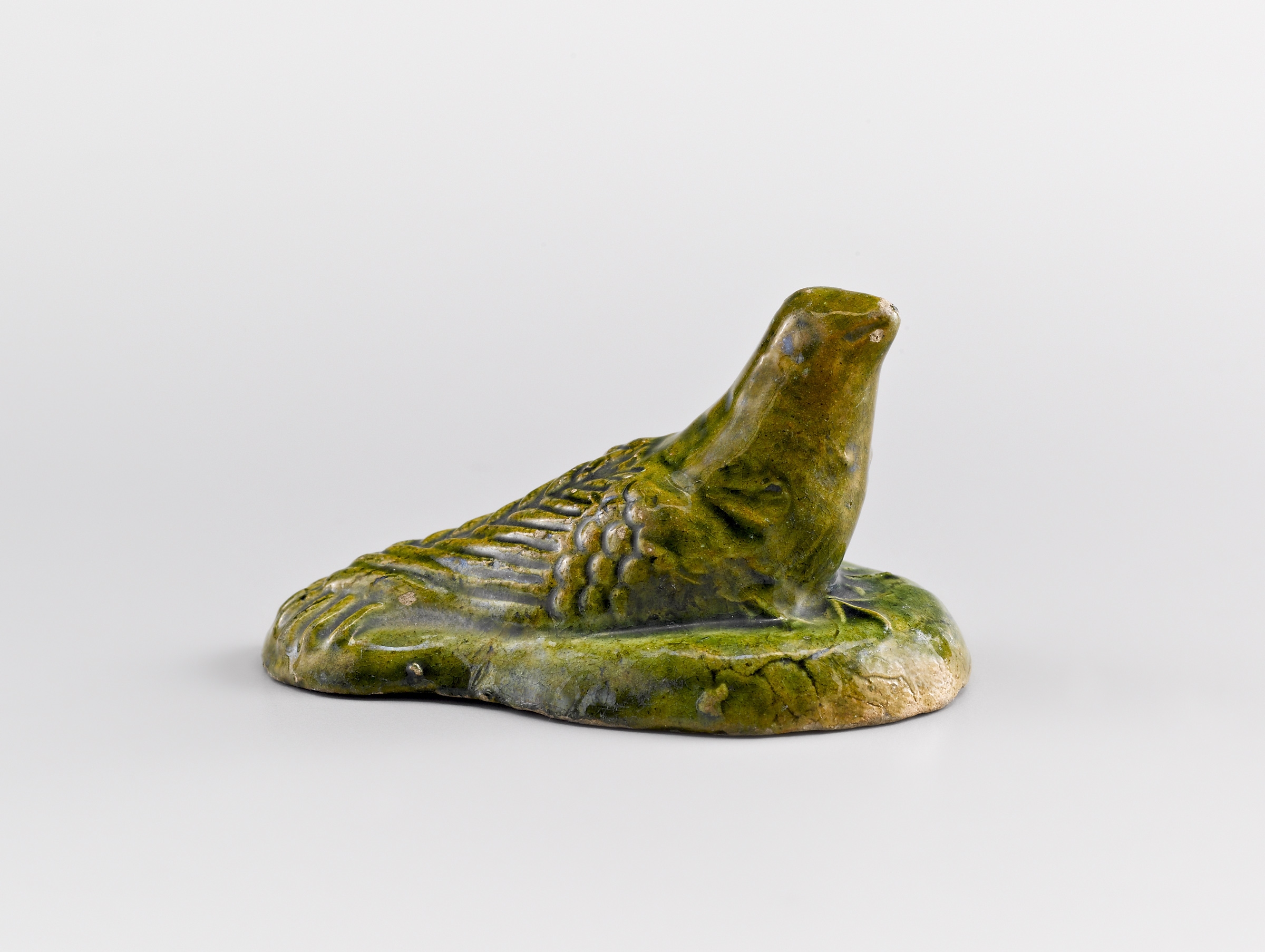
Bird Figurine
Artist/Maker
Shop of Rudolph Christ
Place Made
Salem North Carolina United States of America
Date Made
1810-1829
Medium
lead glazed earthenware
Dimensions
LOA 2 3/4
Accession Number
2551
Description
DESCRIPTION: Earthenware molded toy bird with copper green glaze over a buff paste. Having feathers, feet, and face.
This press-molded bird figurine is lead-glazed earthenware with green glaze.
History
Press Molded
Moravian potters in North Carolina made press-molded earthenware for more than one hundred and twenty-five years. The range of forms documented by surviving objects, molds, and references in pottery inventories is far greater than that of any contemporary American ceramic tradition. From smoking pipes to stove tiles, the Moravian potters at Bethabara and Salem expanded the production of press-molded earthenware to include figural bottles and casters, non-figural bottles, and toys. Rudolph Christ can be credited for the successful production and marketing of pressmolded figural wares during his tenure as master of the pottery at Salem (1789–1821). (Art in Clay Gallery Guide)
Flasks & Figures
Moravian potters made thrown flasks, bottles, and other utilitarian forms long before introducing press-molded variants around 1800. During the first quarter of the nineteenth century, the variety of figural objects listed in the pottery inventories expanded with each passing year. A molded flask with a stylized flower may represent one of the “57 bottles” listed in the 1810 inventory of the Salem pottery or one of the sixty green bottles listed in the 1824 inventory. In 1819 the stock-in-trade of the Salem pottery included eighty-four eagle bottles and plaster molds for producing two different sizes. Of the three bottles known to survive, all are the same size and have green glaze applied on a white slip. The 1819 inventory also listed one hundred and seventy-five “ladies” in three different sizes.
Children enjoyed press-molded wares specially designed for them including doll heads to which cloth bodies could be attached. A figural form likely inspired by contact with Native Americans was the so-called “Indian.” The ceramic Indians listed at 10 shillings each in the 1806 inventory were the most expensive bottles made at the Salem pottery. No examples of this figure or its molds are known to survive.(Art in Clay Gallery Guide)
Birds
Two different owl bottles are listed in the 1806 inventory, a large one priced at 5 shillings and a smaller one at 3 shillings 6 pence. One of the former and two of the latter are known. Chickens designed for dispensing spices or fine powders first appear on the 1810 inventory of the Salem Pottery. The most expensive bird figures were “turkeys” and “geese.” Both forms are listed on the 1806 inventory, valued at 48 shillings per dozen. A few small birds whose molds survive were probably intended as toys. (Art in Clay Gallery Guide)
Also see “Ceramics in America” 2009
Artist Biography
MAKER: Rudolph Christ (1750-1833), the son of Rudolph Christ and Anna Wolf, was born in Lauten, Wurtemberg, Germany. He arrived in Bethabara in 1764 at the age of fourteen. In 1766, he apprenticed to Gottfried Aust, whose shop was in Salem, with whom he had a turbulent relationship. In August, 1770, the Elders Conference noted in its minutes that “Aust and his apprentice Christ have separated again” and Christ had written a letter to Brother Marshall begging to be released from his master and to be transferred to another settlement. After repeated requests, Christ was finally released in 1771, and he became the apprentice to the Salem gunmaker. Due to the lack of business at the gunshop, however, Christ returned to Aust’s pottery in 1772. He was freed of his apprenticeship in either 1773 or 1774, yet he remained in the pottery as a journeyman. Christ learned the art of making Queensware, while Aust continued to produce only earthenware. The young man listed this difference of materials as one of the many reasons he should be permitted to establish his own pottery. Time after time his attempts were thwarted by the Elders Conference, who clearly thought of him as a troublemaker. In 1780, the Elders Conference suggested that he marry Elizabeth Oesterlein, who became his first wife. This marriage gave him further reason to desire to be on his own, and finally in 1785, he received permission to set up his own business in Bethabara. He produced simpler varieties of Queensware such as moulded plates and Oriental form bowls. Many works had a mottled glaze. He had his own apprentices some of whom were Jacob Myer, David Baumgarten, and John Butner, who became master of the Bethabara pottery when Christ returned to Salem. Christ experimented with tin-enameled or faience pottery and grey salt-glazed stoneware which was popular in Pennsylvania. Christ was the master in Bethabara from 1786 to 1789, and then he became the master of Salem from 1789 to 1821.
Credit Line
Gift of R. Philip Hanes