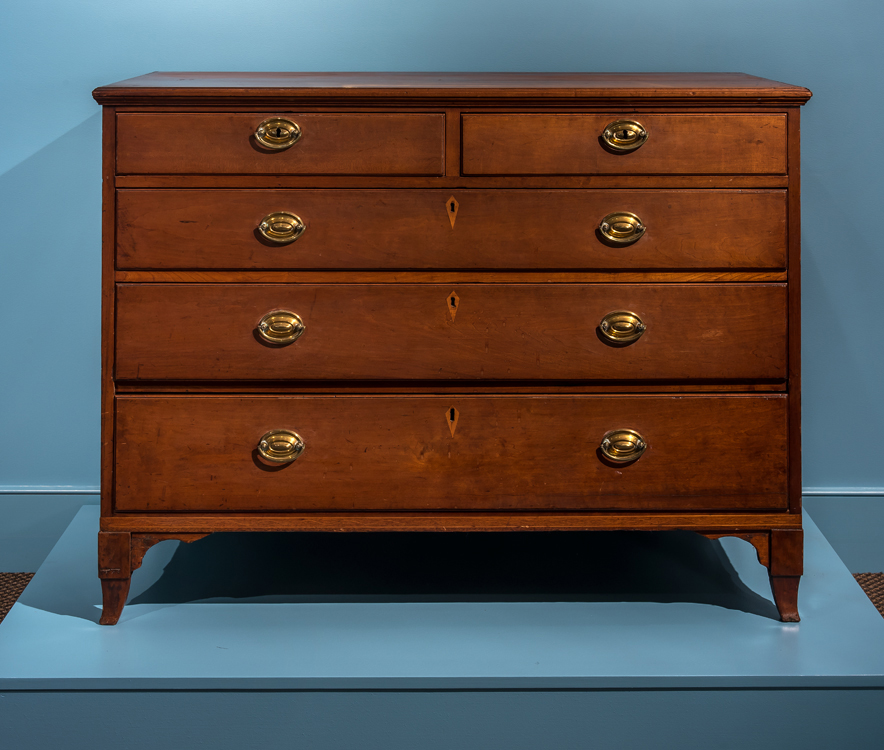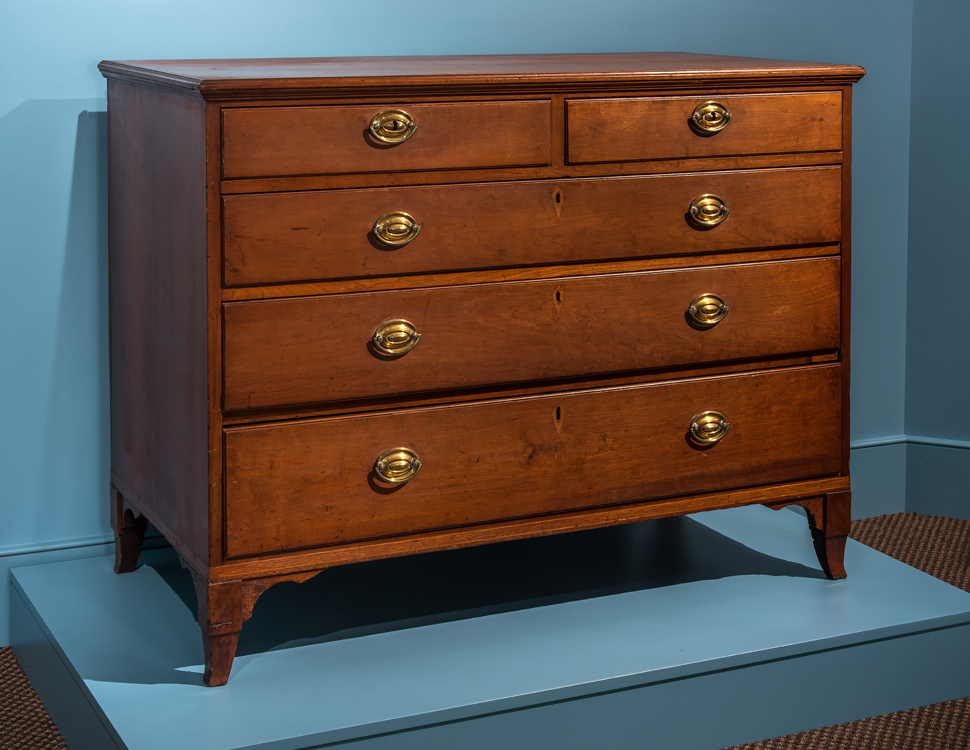
Chest of Drawers
Artist/Maker
Belo, Johann Frederick
Place Made
Salem North Carolina United States of America
Date Made
1806-1827
Medium
cherry, pine & poplar
Dimensions
HOA 36 1/2; LOA 46 1/2; WOA 23 1/2
Accession Number
943.1
Description
DESCRIPTION: Cherry 4-drawer chest, the top tier divided into two drawers, molded top edge, molded drawer edges, decorated with diamond inlaid keyholes and an inlaid narrow panel at base enclosing a rippling line, the whole supported by four legs which are squared on top and flair outward at the bottom. Mounted with oval Hepplewhite brasses.
Johann Frederick Belo arrived in Salem from the Moravian community of Herrnhut, Germany, in 1806. The unusual form of the feet on this chest and other pieces made in this shop is also seen on case furniture made in Herrnhut.
History
LABEL NOTES: This chest of drawers is very closely related to the desk-and-bookcase (#252). In fact, it is not inconceivable that the two pieces once stood together, as they do now. Again, the room inventoris from Pennsylvania suggest that the woman would have a chest of drawers for her clothes, while the man used his desk drawers.
This piece shipped to us with a bookcase top which was apparently made at a later date to go with this chest, numbered #943.2. This piece descended in the Vogler-Senseman family. John Vogler’s daughter, Louise Lauretta, married Edwin Timoleon Senseman in 1844. They moved to Illinois or Indiana. This chest was apparently part of the furnishings they took with them, and was returned to Salem by the Senseman grandchildren.
The brasses are probably replacements.
RELATED NAME: Vogler family
Artist Biography
ARTIST BIO: Johann Frederick Belo (1780-1827) was one of several cabinetmakers to arrive in Salem in 1806. It is generally believed that the 1806 influx of cabinetmakers is responsible for the shift away from the Baroque style in Moravian cabinetmaking and toward a more neo-classical approach. Belo was born in Herrnhut, Germany, where he was trained in the art of cabinetmaking. His memoir indicates that he worked in the table-making shop in Herrnhut prior to coming to Salem. After his arrival, he worked in the Single Brothers’ House joiner shop until 1808 when received permission to set up his own shop. Belo continued to work in Salem until his death in 1827. He is credited with having one of the strongest stylistic impacts on Moravian furniture of the period despite the fact that he suffered from repeated illnesses throughout his life.
Credit Line
Gift of John H. and June Badger Wilson