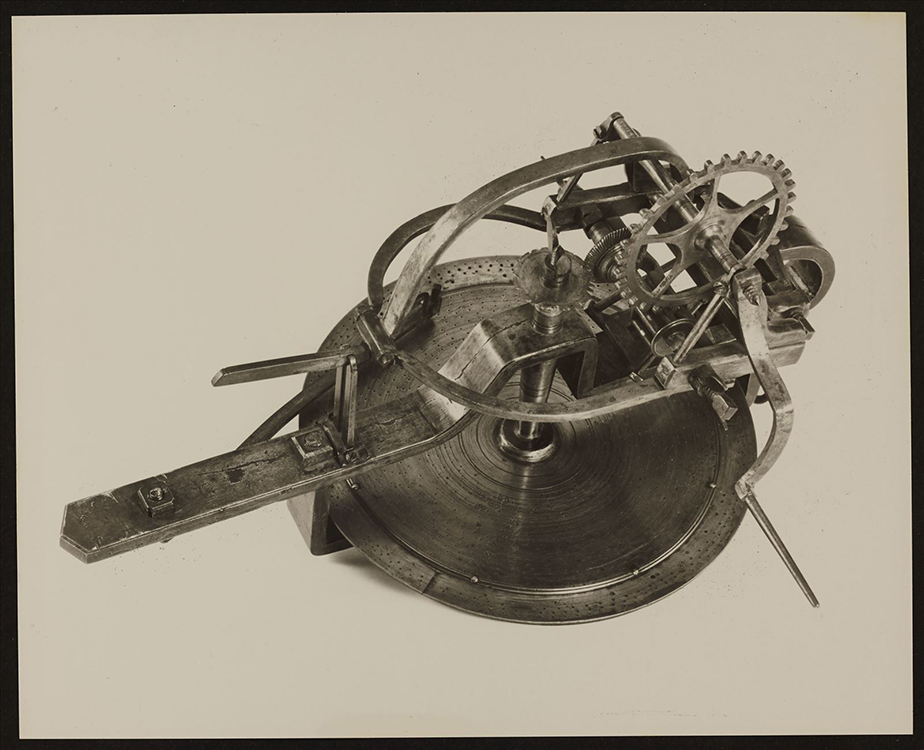

Clock Gear Cutter
Artist/Maker
Eberhardt, Johann Ludwig (attr.)
Date Made
1800-1830
Medium
brass, steel, iron
Dimensions
DIA 9 3/4
Accession Number
C-23
Description
A machine used for cutting clock gears. It cuts gears with the following number of teeth: 96, 78, 84, 72, 56, 66, 54, 48, 62, 32, 30, 24, 31, 52, 40, 35, 28, 20, 10, 100, 119, 120. Also 12 graduated for counting wheels and 12 half around and 12 the other half (counter-clockwise) for repeating clocks.
History
This piece of machinery has a Salem history and is believed to have been made and used by clockmaker Johann Ludwig Eberhardt. Constructed of brass, steel and iron, this device greatly facilitated the work of cutting individual gears for clocks. Virtually all clockmakers in America during the 18th and early 19th centuries imported their clock gears rough cast from one of the factories in England (such as Osborne, which is stamped on some parts found in Salem clocks) and then cut them to specifications in their shops. Gear cutting engines made this work much easier, as it allowed the teeth to be cut at regular intervals, and most engines had settings for up to one hundred different size gears.
It is not clear if Vogler had a machine like this in his shop, but it is not out of the question, and this particular piece is displayed because of its importance.
Artist Biography
Johann Ludwig Eberhardt, North Carolina’s most prolific clockmaker, arrived in the Moravian town of Salem from Germany in 1799 and worked there until 1837. According to an 1809 inventory of his shop, 30-hour clocks such as this sold (without case) for $30.
Credit Line
Wachovia Historical Society