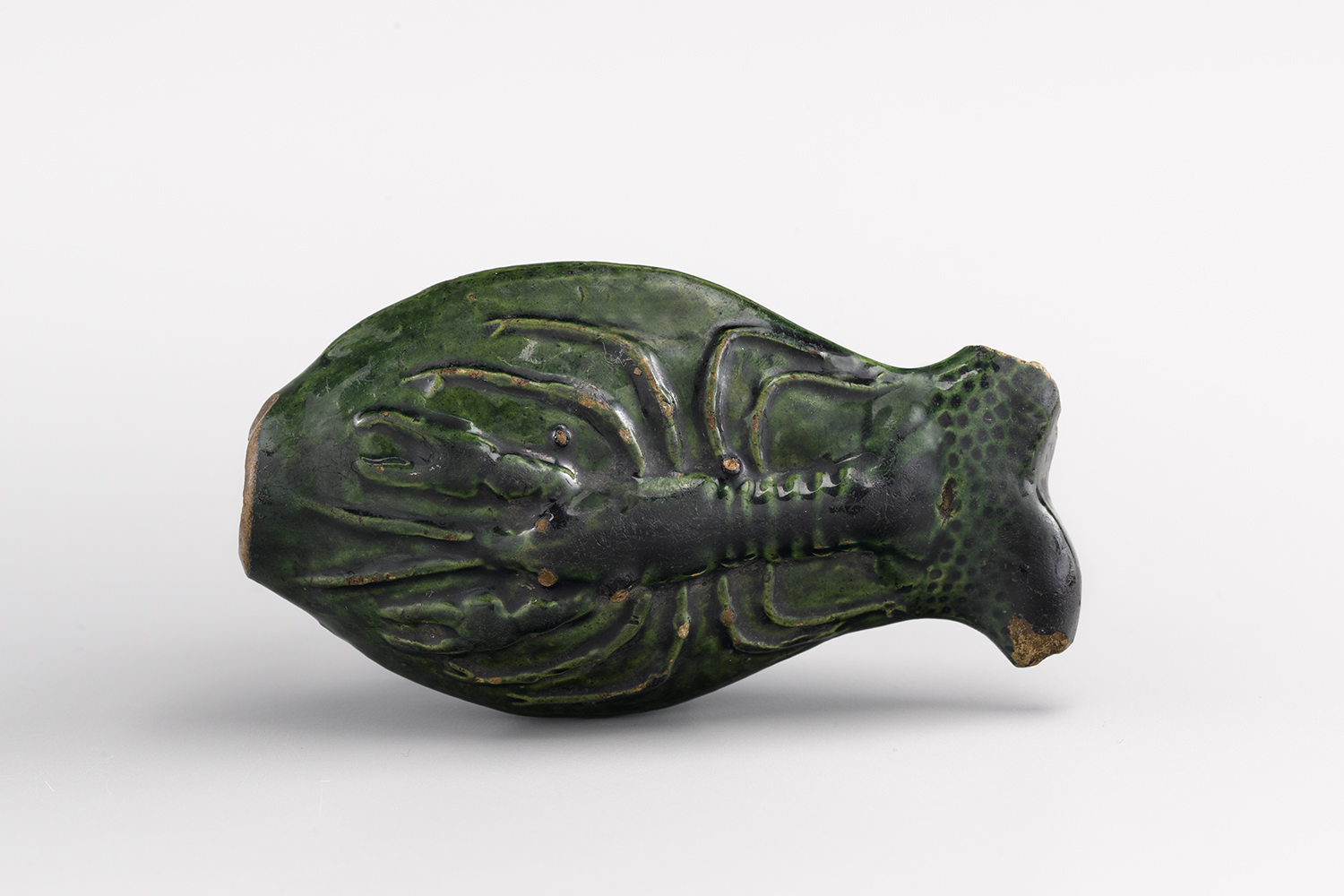
Crayfish Bottle
Moravian potters in North Carolina made press-molded earthenware for more than one hundred and twenty-five years. The range of forms documented by surviving objects, molds, and references in pottery inventories is far greater than that of any contemporary American ceramic tradition. From smoking pipes to stove tiles, the Moravian potters at Bethabara and Salem expanded the production of press-molded earthenware to include figural bottles and casters, non-figural bottles, and toys. A press mold was usually plaster, consisting of two parts with the exterior design of the bottle impressed on the interior of each half of the mold. Once the clay was set up, the molds were removed and the form remained with the impressions of the mold.
Rudolph Christ can be credited for the successful production and marketing of press molded figural wares during his tenure as master of the pottery at Salem
(1789–1821). Rudolph Christ apprenticed under Gottfried Aust in Salem, North Carolina. He established his own pottery in Bethabara in 1786 and worked there until 1789. He succeeded Aust as master potter in Salem from 1789 to 1821. (Ceramics in America 2009) The production of press-molded wares also continued through the tenure of John Holland, who apprenticed under Rudolph Christ and as noted in Moravian records, inherited molds used in Christ’s shop. Rudolph Christ retired in 1821 and John Holland took over as Salem’s third master potter. Although the pottery ceased to operate as a congregational business in 1829, production of press-molded wares continued in the shop of Holland and another Salem, potter, Heinrich Schaffner until at least the middle of the nineteenth century.
Brown, Johanna. “Tradition and Adaptation in Moravian Press-Molded Wares.” CERAMICS IN AMERICA (2009) 105-138.
Erickson, Michelle; Hunter, Robert; and Hannah, Caroline M.”Making a Moravian Squirrel Bottle.” CERAMICS IN AMERICA. (2009): 199-216.
Moravian potters in North Carolina made press-molded earthenware for
more than one hundred and twenty-five years. The range of forms documented
by surviving objects, molds, and references in pottery inventories
is far greater than that of any contemporary American ceramic tradition.
From smoking pipes to stove tiles, the Moravian potters at Bethabara and
Salem expanded the production of press-molded earthenware to include
figural bottles and casters, non-figural bottles, and toys. Rudolph Christ
can be credited for the successful production and marketing of pressmolded
figural wares during his tenure as master of the pottery at Salem
(1789–1821).(Art in Clay Gallery Guide)
Flasks & Figures
Moravian potters made thrown flasks, bottles, and other utilitarian forms
long before introducing press-molded variants around 1800. During the
first quarter of the nineteenth century, the variety of figural objects listed
in the pottery inventories expanded with each passing year. A molded
flask with a stylized flower may represent one of the “57 bottles” listed in
the 1810 inventory of the Salem pottery or one of the sixty green bottles
listed in the 1824 inventory. In 1819 the stock-in-trade of the Salem
pottery included eighty-four eagle bottles and plaster molds for producing
two different sizes. Of the three bottles known to survive, all are the
same size and have green glaze applied on a white slip. The 1819 inventory
also listed one hundred and seventy-five “ladies” in three different sizes.
Children enjoyed press-molded wares specially designed for them including
doll heads to which cloth bodies could be attached. A figural form
likely inspired by contact with Native Americans was the so-called “Indian.”
The ceramic Indians listed at 10 shillings each in the 1806
inventory were the most expensive bottles made at the Salem pottery. No
examples of this figure or its molds are known to survive.(Art in Clay Gallery Guide)
Turtles, Fish and Crayfish
Two different styles of turtle bottles—occasionally described as “terrapins”
on inventories of the Salem pottery—were available when the form
was introduced about 1800. The inventory for that year lists thirty-four
turtles valued at 2 shillings each and thirteen at 1 shilling 6 pence each.
Of all the figural bottles produced at Salem, fish survive in the greatest
number. Most are glazed green on the outside but examples decorated
in tortoiseshell colors are known. Fish appear in the April 30, 1801 inventory
of the Salem pottery valued at 1 shilling 6 pence each. Three sizes
were available the following year, and by 1806 the pottery was producing
four patterns—the number represented by surviving molds listed in the
1828 inventory. One form never mentioned in any of the pottery
inventories is the crayfish bottle, which was made in at least two sizes.
Since its basic shape mimics the fish bottle, it may have been counted as
one of those forms. As was the case with the small turtle bottle, the
molds for the crayfish appear to have been made from a natural specimen.
Only two Moravian crayfish bottles are known, both with green
glaze. (Art in Clay Gallery Guide)
Also see “Ceramics in America” 2009