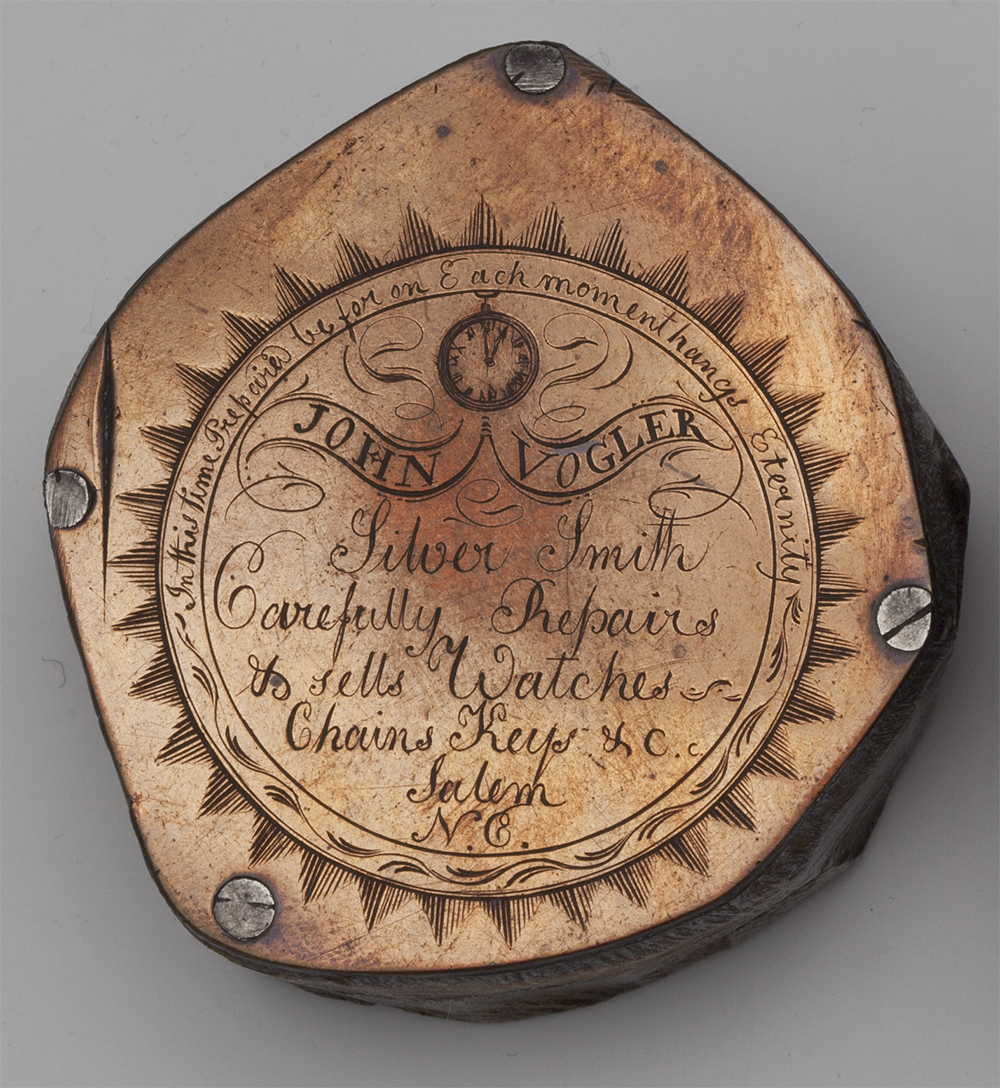
Engraving Plate
This engraved paper plate was used to print a type of advertising called a watchpaper. Watchpapers were placed inside a customer’s watch case after the watch had been repaired. When the owner opened his case to wind his watch, the watchpaper reminded him of who had repaired his watch. This plate is believed to be one that Vogler used at the beginning of his career.
This is one of three extant watch paper plates and is believed to be the plate that Vogler used at the beginning of his career (1806) due to the relatively crude engraving.
DESCRIPTION: Engraving block, copper on wood, to engrave a design consisting of a clock face, set at 11:00, under which is the name John Vogler worked in scrolls and an advertisement. The whole encased in a circle of rays with an inner motto. John Vogler made this engraving block to engrave watch papers for the watches he repaired. Before closing up a watch (after repairing it), Vogler would place a watchpaper inside.
In 1809 Vogler moved into the Single Brothers’ House where he operated a watchmaking and silversmithing shop. Even as a young man he was an astute businessman, importing watches and clocks for resale. He sought permission to marry on seven different occasions between 1814 and 1818 but each time was denied through the Moravian practice of putting marriage proposals to the Lot (one of the women being proposed declined herself). During this time Vogler continued to live and work in Salem’s Single Brothers’ House. The Moravians abandoned the use of the Lot for deciding marriages between lay church members in 1818 and Vogler made a second request to marry Christina Spach, his first choice from four years earlier, and this time his proposal was approved and Christina accepted. The couple was married on 7 March 1819. Vogler designed and made her wedding ring (Acc. 366.1) consisting of three delicate circles of gold with two clasped hands that parted to reveal a double heart engraved with the words “With God and Thee My Joy shall be.” The couple had three children: Lisetta (1820-1903), Louise (1822-1854), and Elias Alexander (1825-1876).
An artist as well as a craftsman, Vogler was responsible for several exterior details on his house including the brass doorknob shaped like a fist holding a rod that graces the front door. He also designed the pedimented hood over the front door with its decorative glass fan and the painted clock face that advertised his trade. In his silversmith shop in a front room of his house, Vogler’s business grew far beyond what he had achieved in the Single Brothers’ House. Part of his success lay in his versatility. He worked with different metals, making and selling a wide array of objects. See John Bivins and Paula Welshimer, “Moravian Decorative Arts in North Carolina: An Introduction to the Old Salem Collection” (Winston-Salem, NC: Old Salem, 1981), George Barton Cutten and Mary Reynolds Peacock, “Silversmiths of North Carolina, 1696-1860”, 2nd rev. ed. (Raleigh: North Carolina Department of Cultural Resources, Division of Archives and History, 1984), and Penelope Niven and Cornelia Wright, “Old Salem: The Official Guidebook,” 3rd rev. ed. (Winston-Salem, NC: Old Salem, 2011).