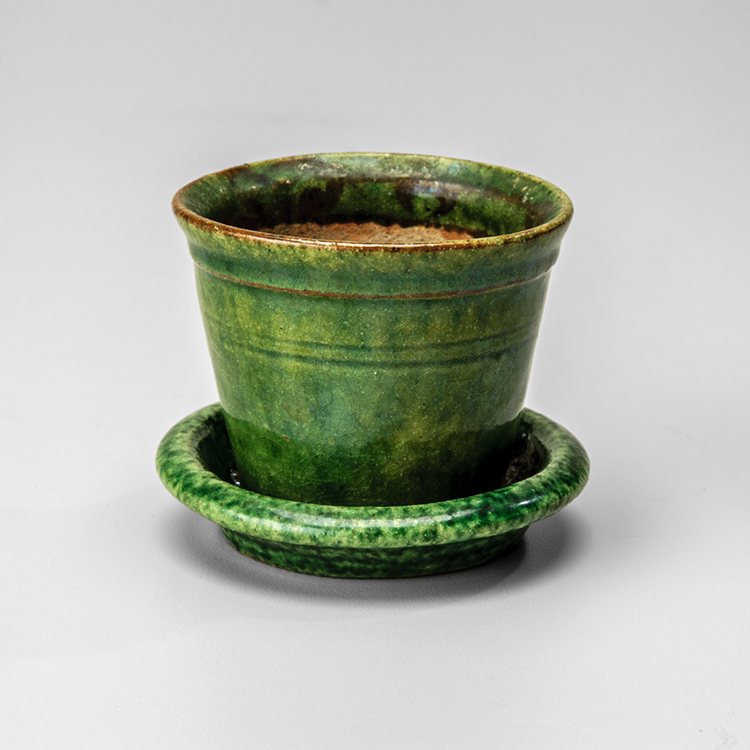
Flower Pot and Saucer
It was not until November 15, 1833, that the Salem Diary recorded that “the single Br. Heinrich Schaffner arrived here today from Neuwied [Germany] in hope of finding work at his profession as potter.” A few days later, the minutes of the Elders Conference note that “for the time” Schaffner would “find employment with the potter, John Holland.” By the following April, however, Schaffner had become dissatisfied with his lot…
Schaffner applied for permission to purchase the aging 1766 log “Builders House” located on Lot 81 to set up his shop, and permission was granted. In 1835 Schaffner officially became a citizen of Salem and married his uncle’s stepdaughter, Levina Hauser. For his own use Schaffner, who had been living with his uncle, renovated the 1812 Schulz House located on the same lot as his pottery.
The records of Henry Schaffner are somewhat sparse for two principal reasons: he was operating his own business, rather than one belonging to the congregation, and record-keeping in Salem simply was not as detailed later in the nineteenth century as it has been previously. However, after Holland’s death in 1843, the records do not that Schaffner had applied for permission to dig his clay in “Blum’s meadow,” where the potters had dug for more than seventy years. This meadow was located just east of Church Street on what is now Salem College grounds. It was agreed that the meadow would be rented to Schaffner “under condition that he would have to return it or allow to have clay dug on the pasture in case another potter establishes himself here in Salem.” Schaffner was warned that he was responsible for the upkeep of the place. The Collegium remembered very well that various past potters had not been good about back-filling the unsightly holes left by the mining of clay.
In 1846, Schaffner announced that he had “taken a boy by the name of Daniel Krause into his shop to teach him the potter’s trade.” Krause was to become Schaffner’s chief journeyman, and was also to take over the pottery shop and its production after Schaffner retired. We do not know exactly what year Schaffner turned the business over to Krause, but it was probably some time before his death on June 24, 1877. The earthenware business was not longer really a profitable one, and Schaffner’s old pottery establishment was barely to outlast the end of the century.” (Bivins, p.42-44)