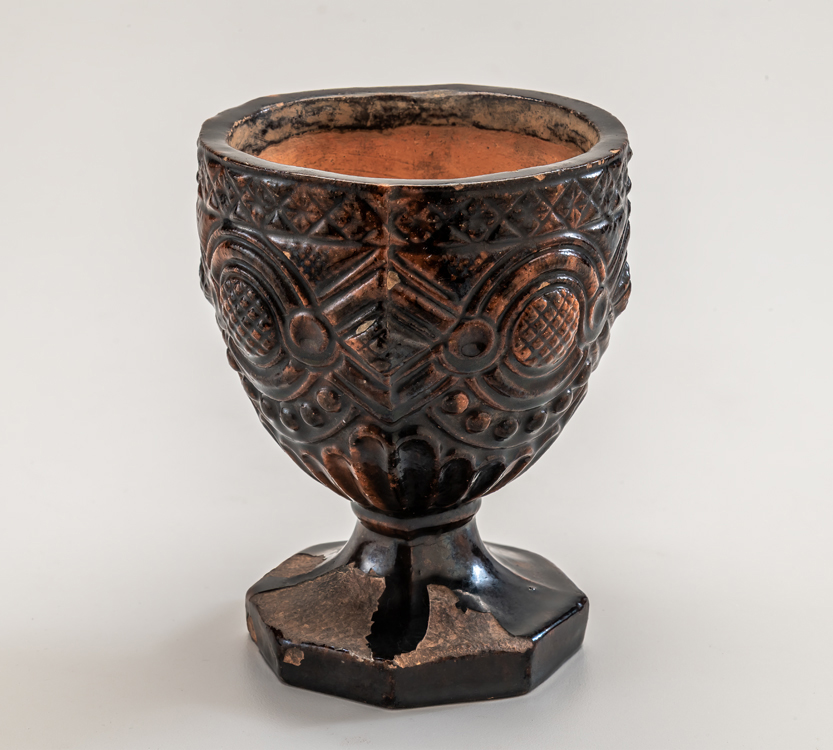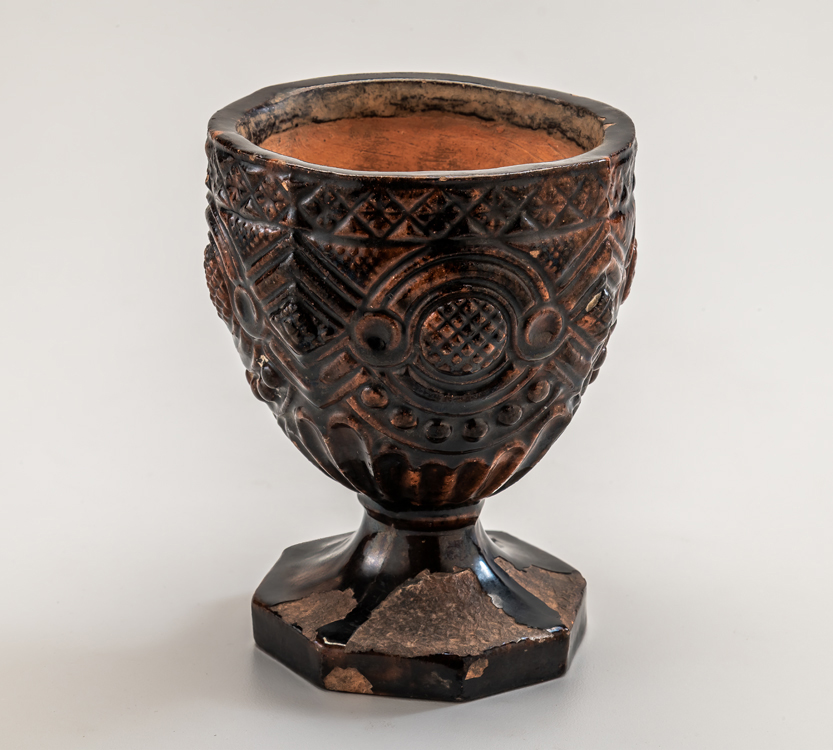
Goblet Flowerpot

Artist/Maker
Schaffner, Heinrich
Date Made
1835-1845
Medium
Lead-glazed Earthenware
Accession Number
6063
Description
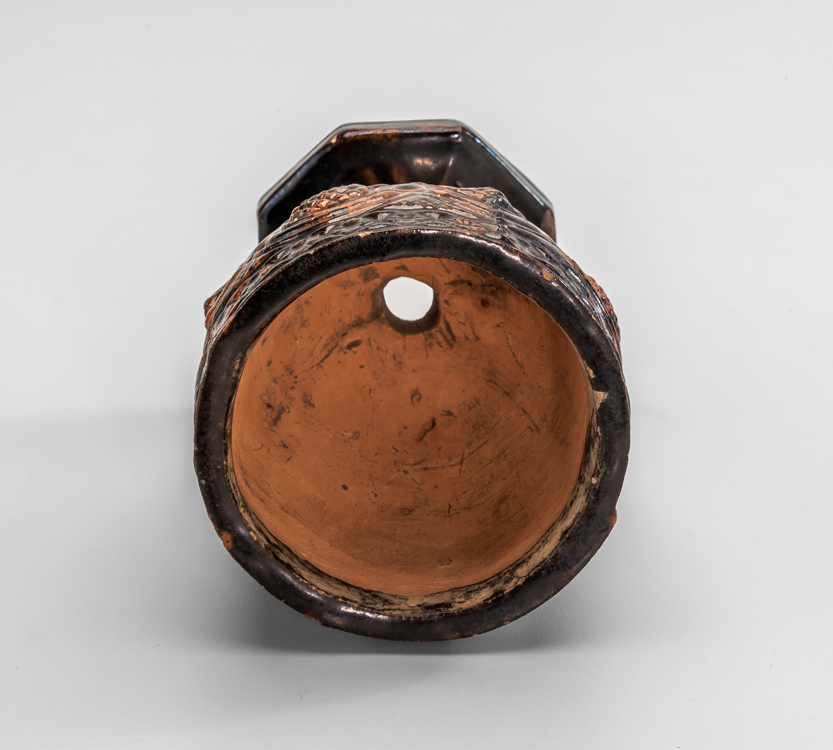
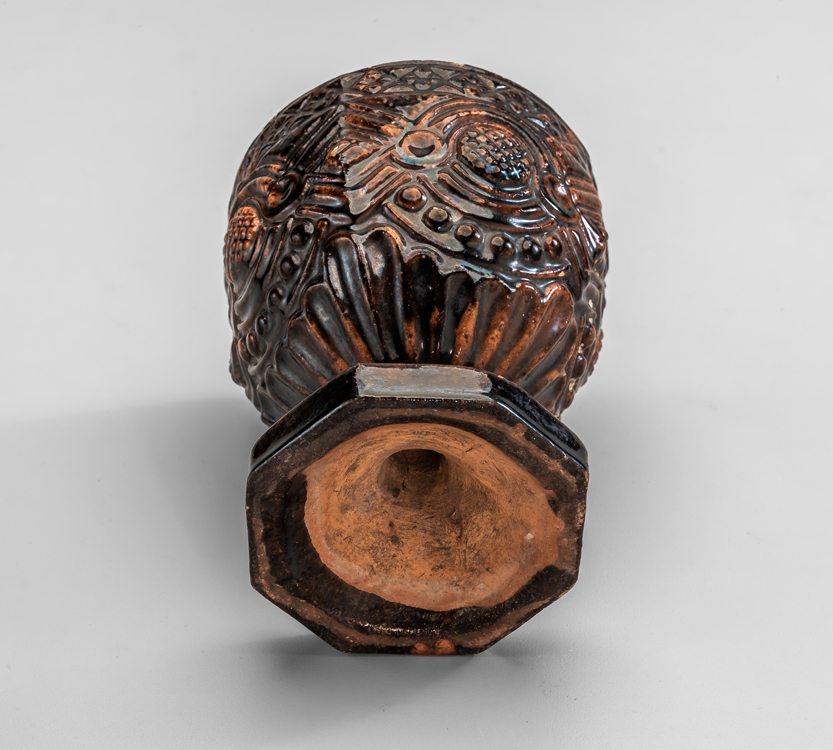
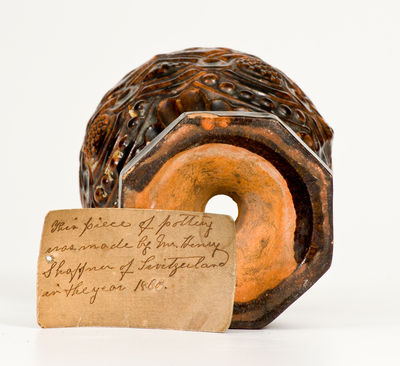
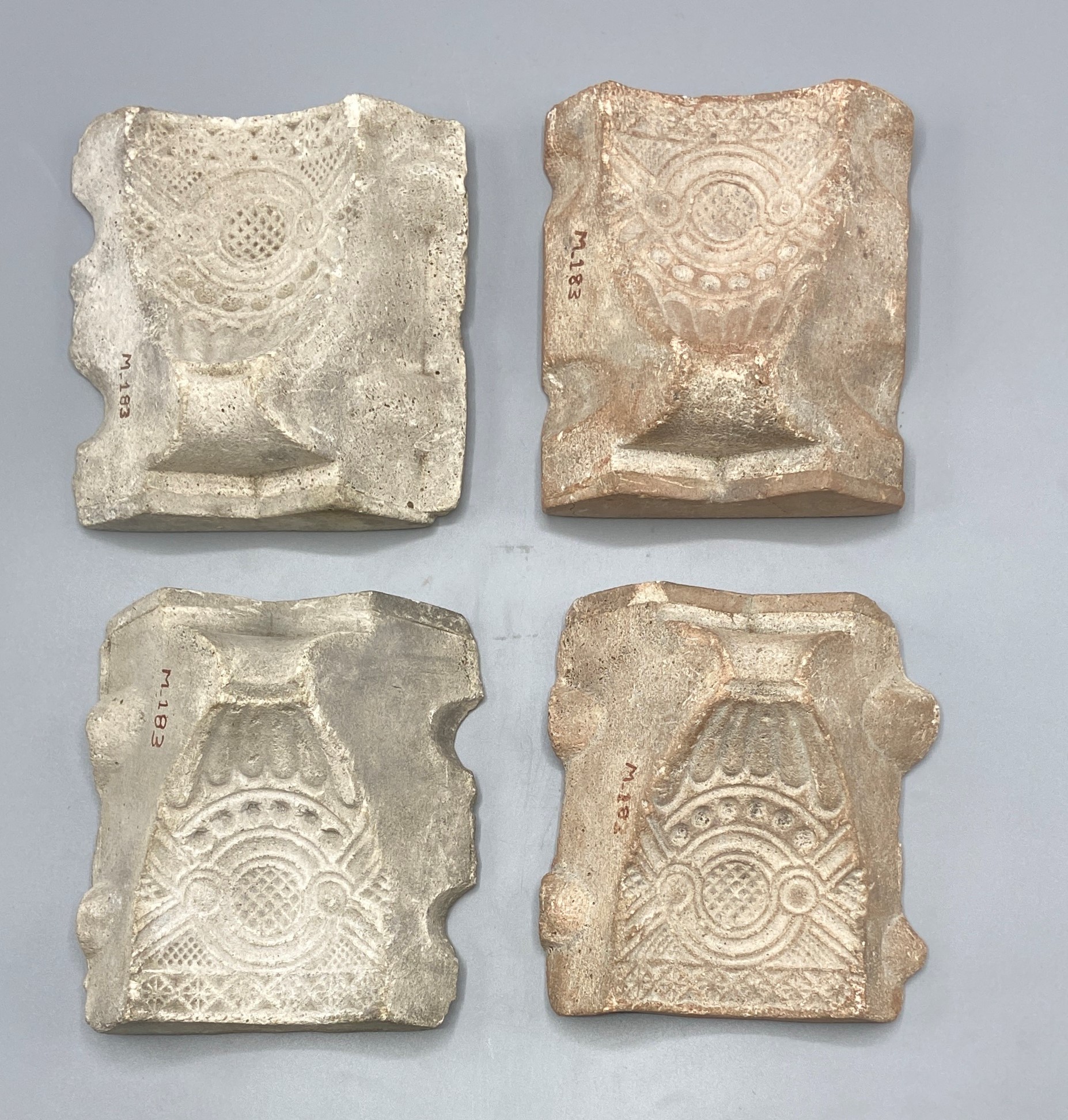
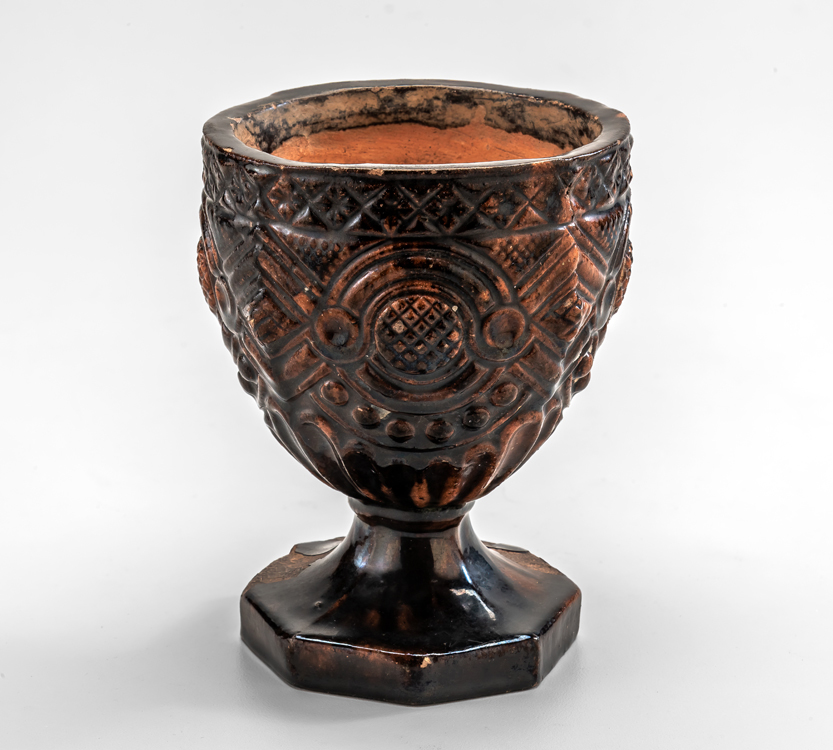
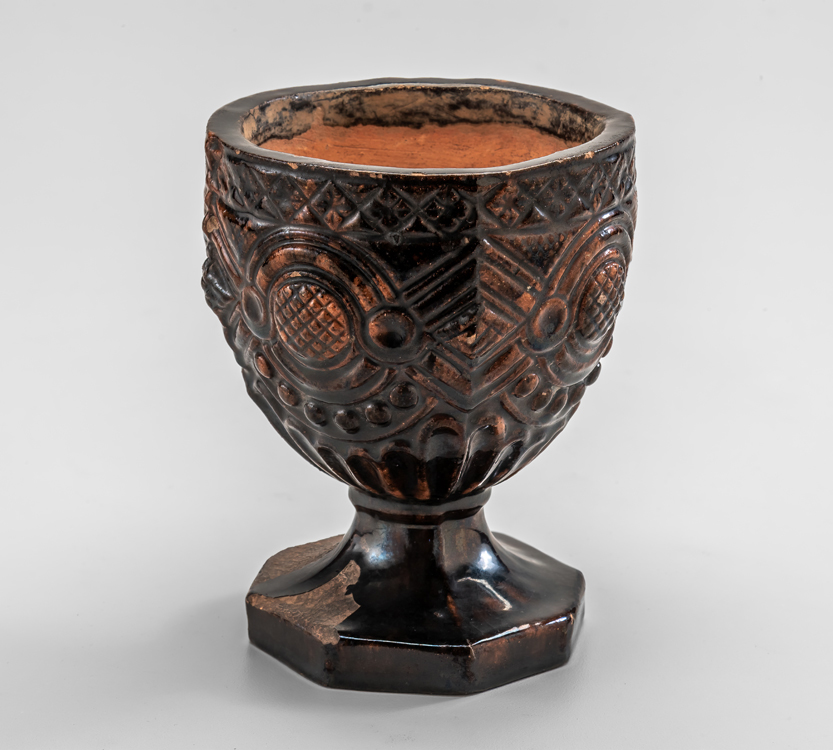
DESCRIPTION: Small press-molded lead glazed earthenware goblet or chalice-shaped flower pot; exterior glaze is very dark brown mottled with orange (the darkest brown is manganese; orange areas are clear lead glaze over the body). Cup was formed using 4 molds (see images of Acc. M-183); base was formed using another mold(s). The press molded design is a combination of diamonds, circles, cross hatching, and swags, and is reminiscent of press molded glass vessels. Jeffrey Evans wrote in correspondence that the pattern is :“a stylized version of the Roman Rosette pattern [in pressed glass]. The form is that of an English rummer or just a chalice. [There’s] nothing exactly like it in glass, but [it is] certainly loosely based on glass from the 1830’s.”

History
The maker of this goblet-shaped flower-pot, Heinrich Shaffner (1798-1877), arrived in Salem, North Carolina, in 1833 to work in the pottery of then master potter John Holland. Trained in Neuwied, Germany, Shaffner was a skilled tile stove maker prior to his arrival in North Carolina, although his training included other pottery production as well. After working with Holland for less than a year, Shaffner petitioned the Aufseher Collegium to allow him to open his own pottery. In his petition, told the board that “he wished to manufacture only small fancy articles which Holland cannot make….” The board granted Shaffner’s request noting, “we regretted that he could not take over the pottery altogether in Holland’s place: the latter shows little zeal in carrying it on.” (Minutes of the Aufseher Collegium, April 14, 1834).

This small press-molded flower pot is exactly the kind of “fancy article” Shaffner produced in the early years of his pottery. The mold for this piece is in the Wachovia Historical Society Collection (see image below). The model used to make the mold was almost certainly based on a press molded glass form. Jeffrey Evans supported my speculation about this by adding, that the pattern is “a stylized version of the Roman Rosette pattern [in pressed glass]. The form is that of an English rummer or just a chalice. [There’s] nothing exactly like it in glass, but [it is] certainly loosely based on glass from the 1830’s.”

Ex. Coll: Frank Horton and Brad Rauschenberg at separate times.

Artist Biography
MAKER: Heinrich (Henry) Schaffner son of Jacob and Mary Schaffner. He was born March 28, 1798 in Switzerland and died June 24, 1877 in Salem. He married Lavinia Hauser (first wife) and Emilia Meinung (second wife). He had Two children by his first wife: Maria Catharina and John Francis. He had three children by his second wife: Louisa Carolina, Sarah Elisabeth and Cornelia Lisette.

“Schaffner…arrived in Salem in 1833. An industrious sort, Schaffner was placed with John Holland but shortly found that he could not remain in that situation and applied for permission to open his own shop. He was allowed to purchase the old 1766 [Builder’s House] near the northwest boundary of Salem, the members of the Collegium stating at the same time that they [regretted…that Schaffner could not take over the pottery altogether in Holland’s place; the latter shows little zeal in carrying it on.] Schaffner carried on what evidently was an excellent trade in both fancy and utilitarian wares, though his shop increasingly had to compete with inexpensive and readily available imported ironstone and other such manufactured ware. The heyday of the potteries in Wachovia had occurred in the eighteenth and early nineteenth centuries, when there was no competition from the outside. Nonetheless, Schaffner’s pottery continued to operate until the end of the century – after the 1870’s in the hands of Schaffner’s former apprentice, Daniel Krause, who was Salem’s last potter.” (Bivins & Welshimer, p.38-39)
Credit Line
Anne P. and Thomas A. Gray Moravian Decorative Arts Purchase Fund