



Inkstand

Artist/Maker
Holland, John
Place Made
Salem North Carolina United States of America
Date Made
1810-1813
Medium
earthenware –lead-glazed
Dimensions
WOA 4 3/4; LOA 5
Accession Number
2632
Description
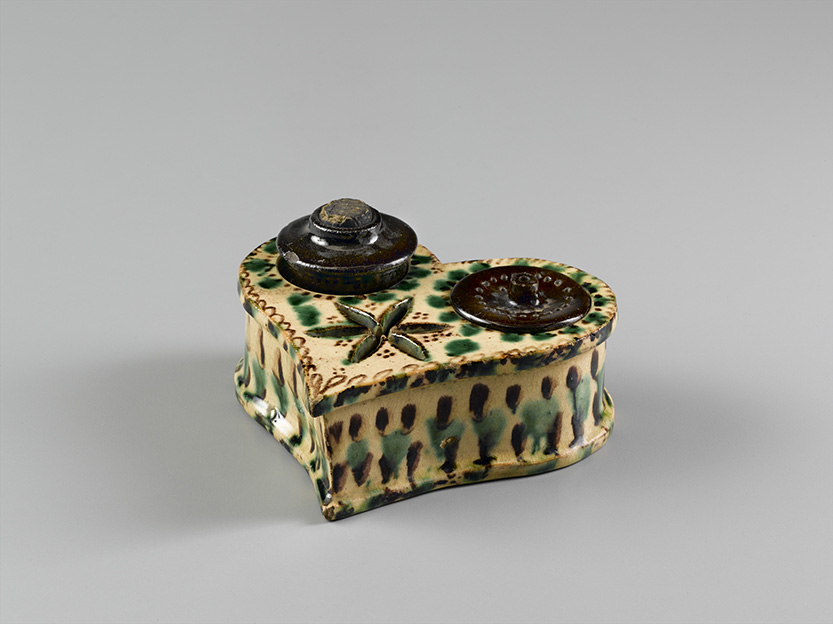
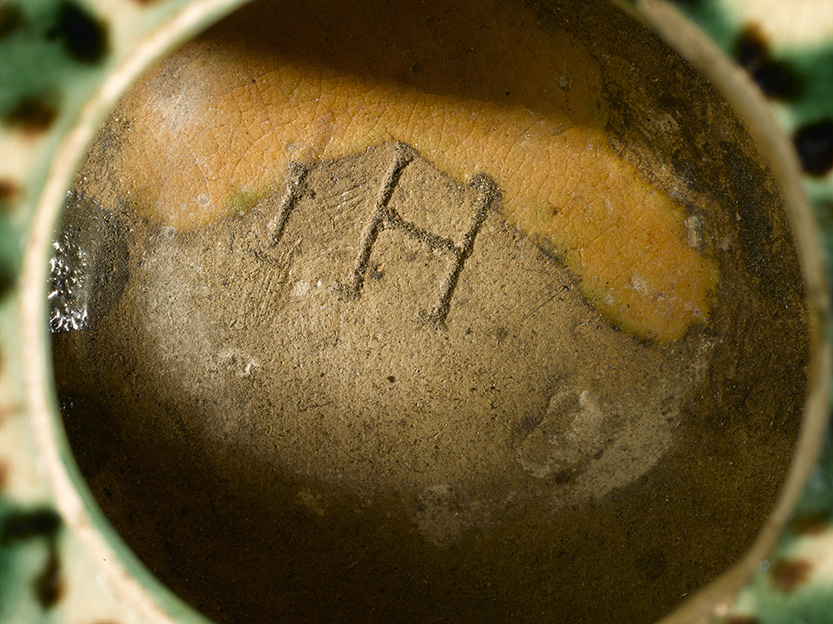
In the form of a heart, this inkstand is made of slabs of clay, one on the top, one on the bottom, and a strip of clay for the sides, molded together on the edges and decoratively pierced. The top is pierced with a six-pointed star. The top is also fitted to hold an ink well and a sander, both of which are wheel-thrown and glazed with a brown manganese lead glaze. On the interior in the base of the inkstand are the initials “I[J]H” for John Holland, one of the succession of Moravian potters working in Salem, North Carolina. The stand after its construction was coated in a white slip, and then decorated with manganese and copper slips. Under the lead glaze, this makes a yellow, brown, and green appearance.

John Holland apprenticed under potter Rudolph Christ and as noted in Moravian records, inherited molds used in Christ’s shop. Rudolph Christ retired in 1821 and John Holland took over as Salem’s third master potter. His tenure was short lived, however, and the pottery ceased to operate as a congregational business in 1829.

History
See “Ceramics in America” 2009, pp. 105-138.
Artist Biography
MAKER: John Frederic Holland, 1781-1843 (apprentice, 1796-ca. 1803; Journeyman, ca. 1803-21; Master in Salem, 1821-43). He was the son of John Holland of Cheshire, England, and Mary Margaret Strub of Salem. John was apprenticed to Rudolph Christ. Christ noted that Holland was “doing very well” and decided to have the boy “contracted to him as usual.” After an apparently uneventful apprenticeship, Holland was freed of his bond on December 28, 1802, with Christ having noted that he had “exchanged the indentures with his apprentice.” Holland was twenty-one and eligible to work inthe shop as a journeyman, which he agreed to do. Evidently Christ considered him trustworthy, for after a series of break-ins at the pottery the following year, Holland was asked to sleep at the pottery, along with the apprentice Joseph Stockburger, to drive off thieves.

Not a great deal is recorded about John Holland’s years as a journeyman in the pottery, probably indicating that he gave Christ no trouble. That his reputation was good is borne out by the fact that it was automatically assumed by the Collegium that he would take over the pottery when Christ decided to retire, which he did.

Unfortunately, Holland was not as successful with the pottery as Christ had been. Despite his apparent laziness, he was a skilled potter.
Credit Line
Gift of Mr. G. Wilson Douglas, Jr.