

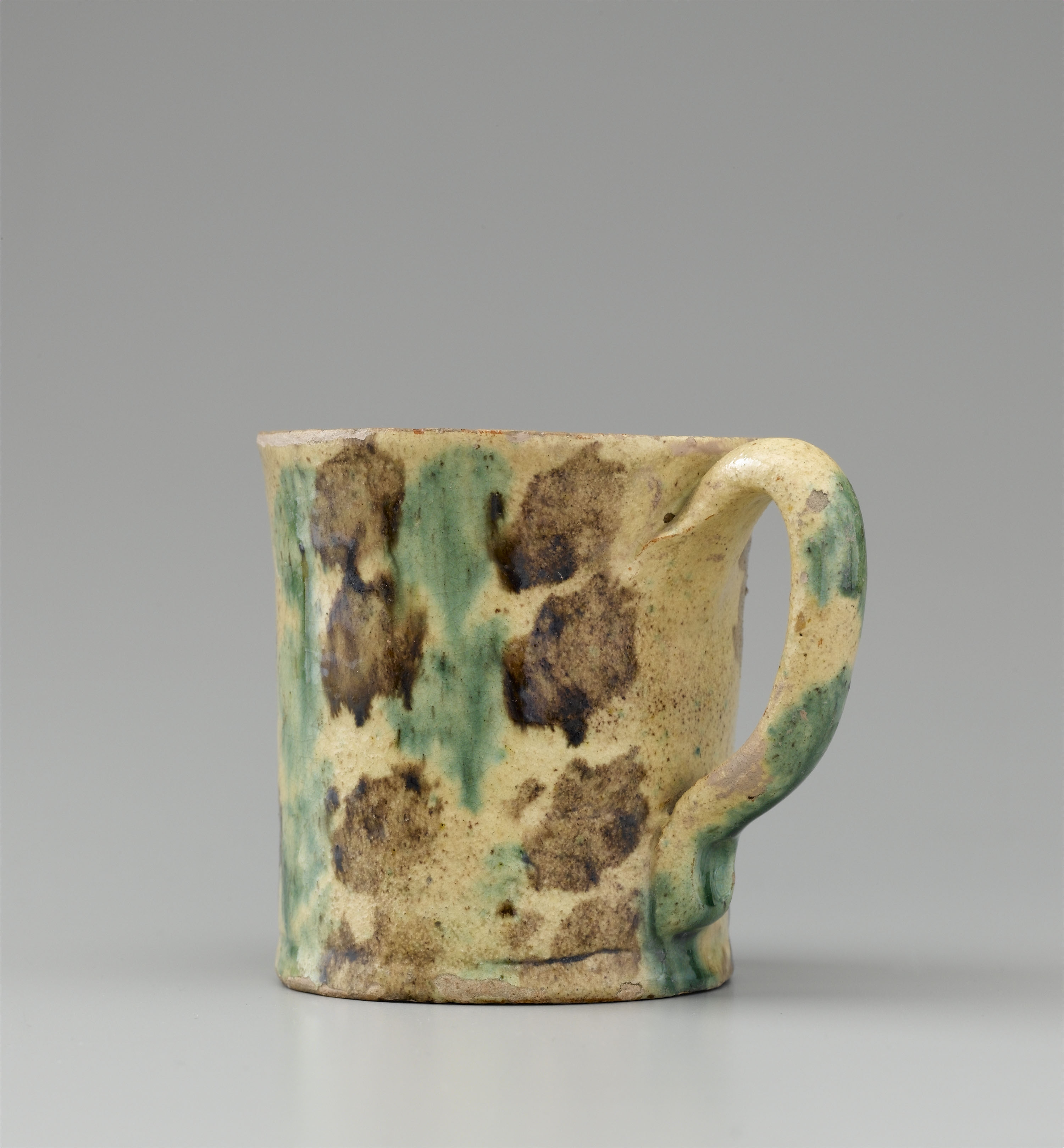
Mug

Artist/Maker
Shop of Rudolph Christ
Place Made
Salem or Bethabara North Carolina United States of America
Date Made
1780-1800
Medium
earthenware/redware
Dimensions
HOA 3 1/2; DIA 3 1/4
Accession Number
935
Description
DESCRIPTION: Mug, slightly concaved sides and long handle. Cream yellow glaze with alternating green and brown splatches in vertical rows on the outside. Indentation made on the bottom of the fresh clay with a dull tool in the form of a large 6.

The Salem pottery began producing imitations of Staffordshire creamware
during the early 1770s, owing to the arrival of an anonymous “itinerant
painter-potter” who had worked at John Bartlam’s “POTTER Y and
CHINA MANUFA CTORY” in Charleston, South Carolina, and William
Ellis, who had worked for Bartlam at Pine Tree (Camden), South
Carolina. During Ellis’ brief stay in Salem, the Moravians built a special
kiln for firing refined earthenware and experimented with the production
of stoneware. The earliest efforts to manufacture pottery using what the
Moravians called the “English fabrique” occurred during Gottfried Aust’s
tenure as master, but it was his former apprentice Rudolph Christ who
developed that class of ware into a marketable commodity, first at
Bethabara (1786–1789) and later at Salem when Christ became master of
the pottery (1789–1821).

The potter from Pinetree… has made a trial burning of
Queensware, also another with Stoneware, whereby the
processes necessary for it are pretty well made known to
us. But since all of these wares now have to be made on
the pottery molds by hand and are not turned on a potter’s
wheel with instruments, they obviously do not have
the porcelain standard of delicateness, but they do serve
as a sideline for our pottery, for recommendation and
further development.
Frederic William Marshall
Administrator of Wachovia
April 5, 1774
Brother Christ… would like to start the fine pottery
here in the community. The fine pottery cannot be manufactured
together with the rough pottery, because the
finest grain of sand that comes into the white clay, will
do great damage, and as concerns the drying, just the
opposite has to be done with the one than the other.
Thus he would need his own pottery and new tools…. If
it would not cost too much money we could then maybe
erect a house and some buildings for it and he could
maybe follow the trade better than it has been done up
to now, he could then also take up the manufacturing of
white, black, and salt pottery. It would also be good to
get him away from Br. Aust because the two temperaments
are too different to get along with each other.
Moravian Records
September 12, 1780
(Art in Clay Gallery Guide)
History
LABEL NOTES: Aquired locally and was probably made in Christ’s shop.
Artist Biography
MAKER: Rudolph Christ (1750-1833), the son of Rudolph Christ and Anna Wolf, was born in Lauten, Wurtemberg, Germany. He arrived in Bethabara in 1764 at the age of fourteen. In 1766, he apprenticed to Gottfried Aust, whose shop was in Salem, with whom he had a turbulent relationship. In August, 1770, the Elders Conference noted in its minutes that “Aust and his apprentice Christ have separated again” and Christ had written a letter to Brother Marshall begging to be released from his master and to be transferred to another settlement. After repeated requests, Christ was finally released in 1771, and he became the apprentice to the Salem gunmaker. Due to the lack of business at the gunshop, however, Christ returned to Aust’s pottery in 1772. He was freed of his apprenticeship in either 1773 or 1774, yet he remained in the pottery as a journeyman. Christ learned the art of making Queensware, while Aust continued to produce only earthenware. The young man listed this difference of materials as one of the many reasons he should be permitted to establish his own pottery. Time after time his attempts were thwarted by the Elders Conference, who clearly thought of him as a troublemaker. In 1780, the Elders Conference suggested that he marry Elizabeth Oesterlein, who became his first wife. This marriage gave him further reason to desire to be on his own, and finally in 1785, he received permission to set up his own business in Bethabara. He produced simpler varieties of Queensware such as moulded plates and Oriental form bowls. Many works had a mottled glaze. He had his own apprentices some of whom were Jacob Myer, David Baumgarten, and John Butner, who became master of the Bethabara pottery when Christ returned to Salem. Christ experimented with tin-enameled or faience pottery and grey salt-glazed stoneware which was popular in Pennsylvania. Christ was the master in Bethabara from 1786 to 1789, and then he became the master of Salem from 1789 to 1821.