
Physiognotrace or Silhouette Machine

Artist/Maker
Vogler, John
Place Made
Salem, North Carolina
Date Made
1810
Medium
cherry –walnut –brass –iron –tin
Dimensions
HOA 12-1/2″; WOA 5-13/16″; LOA 18-9/16″
Accession Number
M-6
Description
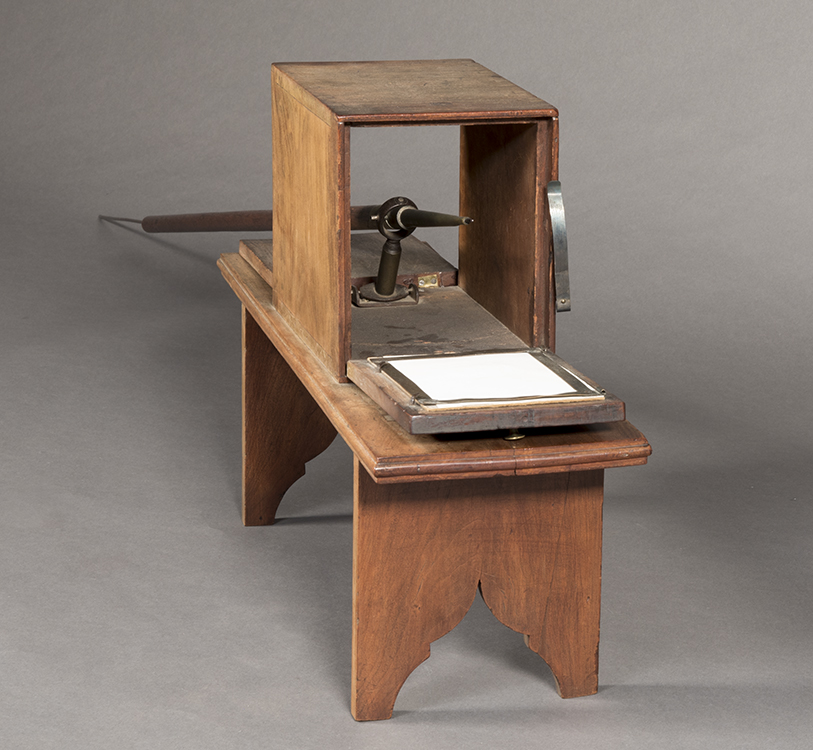
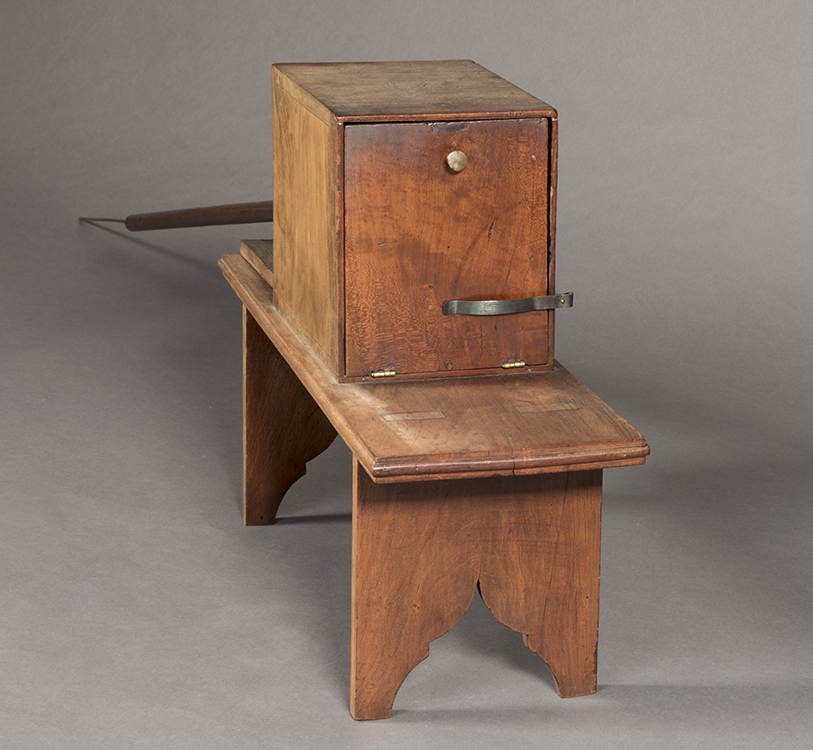
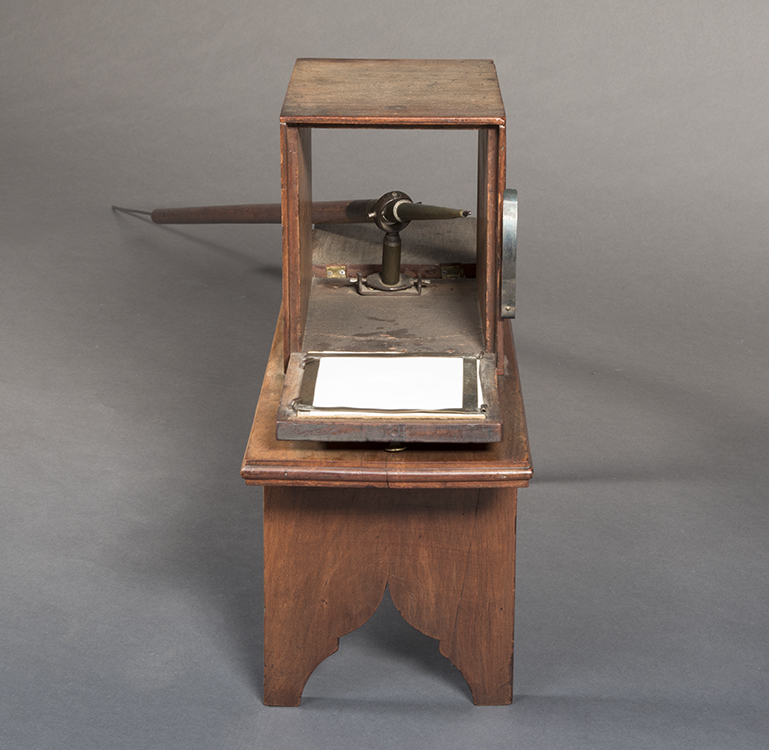
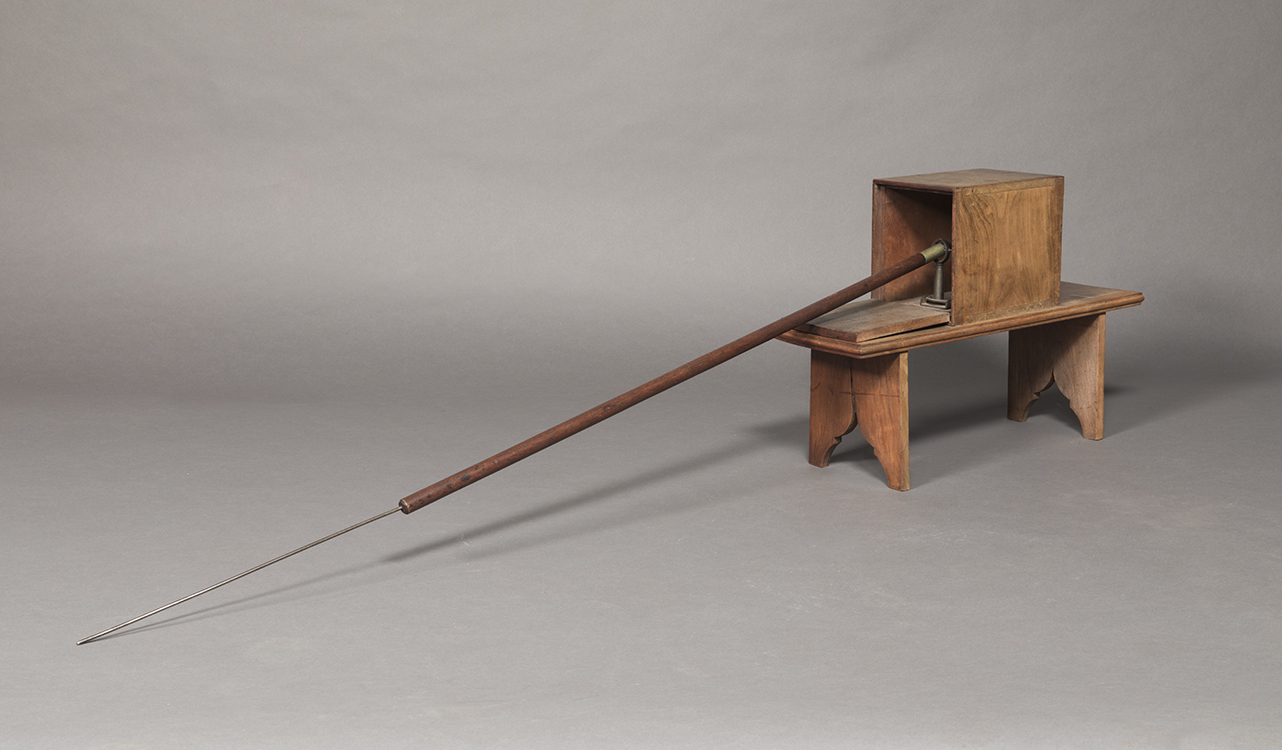
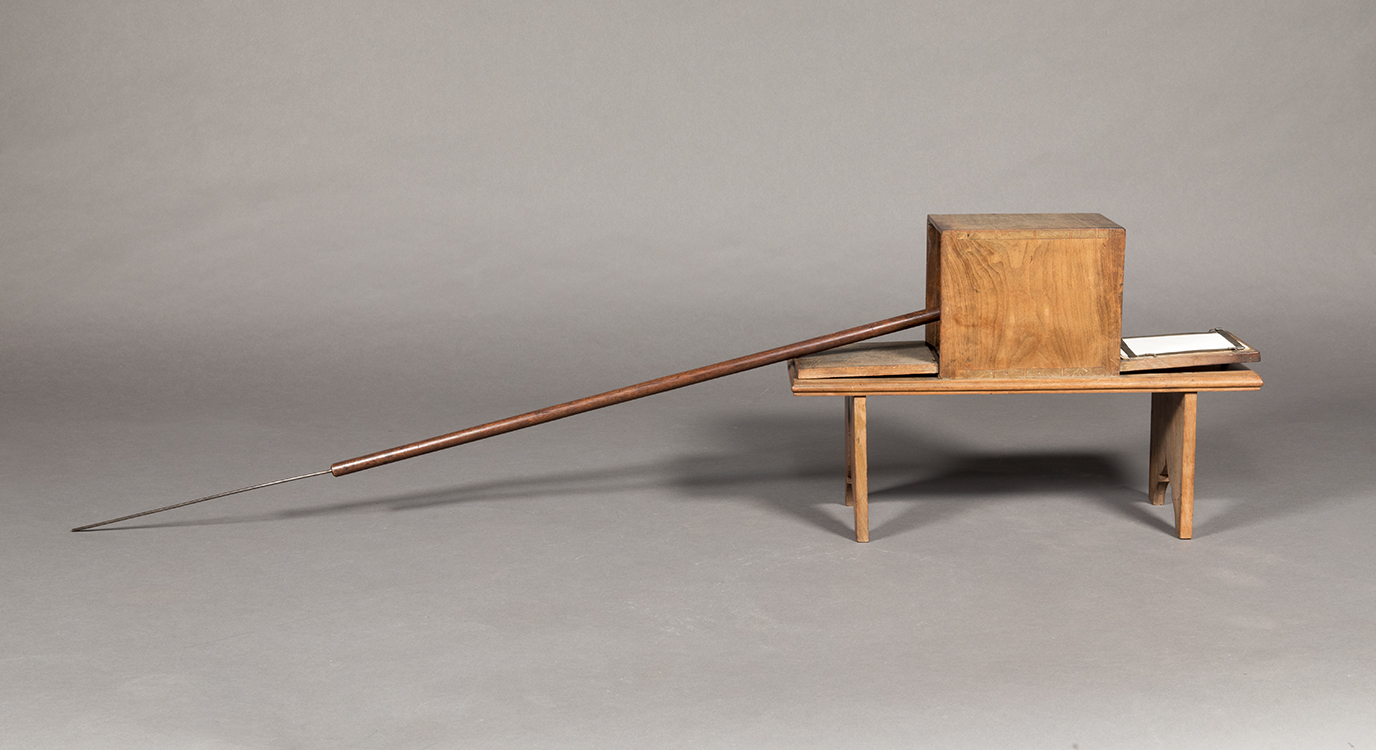
Cherry physiognotrace with brass and iron fittings. The body of this piece consist of a base that resembles a footstool; having a decorative molded edge and two shaped plank legs with mortise and tenon construction. The rectangular box on top of the base is held into place by two screws underneath; the box itself has dovetailed construction. The box has two doors on the each end that open up with two brass hinges holding each door in place; one door has a small brass pull knob. The door with the pull has four iron pins that hold the paper and tin frame in place for tracing; two of the pins do not appear to be original; a thin tin piece is pinned to an iron mount, which is on the right side of this particular door, and holds the door shut. The interior has a pivoting piece made of brass with a ring at the top; the piece moves forward and backward and the tracing rod fits through the ring, the ring is then tightened. The rod is made up of shaped walnut with a long metal rod at the hand-held end and a metal tip on the other.
History
LABEL NOTES: This machine was used to trace a person’s face to one-eighth of its natural size by means of following the rod along the facial outline of a subject seated in a chair. The outline, impressed on paper placed in the opposite end, was then cut out with tiny scissors to form what was called a profile- the modern term being silhouette. Family tradition states that this cherry machine was made by John Vogler after a trip to the Peale Museum in Philadelphia where his profile (which is in the collection) was cut by means of a similar device. While it cannot be ascertained for certain whether or not Vogler actually constructed this machine, it is fairly certain that he employed it in his shop. In fact, family tradition states that Vogler loved to cut profiles and would call people in off the street to do it. Vogler was certainly prolific at this art- dozens of profiles of well known and unknown local residents cut by Vogler survive. Three profiles attributed to Vogler are on display in the 2nd floor sitting room in Vogler’s house.
RELATED NAME: Vogler, John (owner)
Artist Biography
One of the most prominent artisans in the North Carolina Moravian community in the nineteenth century was John Vogler (1783-1881). Born in Friedland, North Carolina, a Moravian settlement near the central congregation town of Salem, he was trained as a gunsmith in Salem by his uncle, Christoph Vogler (1765-1827), and learned the craft of silversmithing from his uncle as well as from Moravian silversmiths in Pennsylvania. A versatile craftsman, Vogler also repaired watches and clocks, made jewelry, a variety of tools, and a physiognotrace (Acc. M-6) for tracing profiles or silhouettes. His inventiveness and skill made John Vogler a successful businessman as well as one of Salem’s most well-known and respected artisans. Late in life he wrote of himself: “Industry was never a burden to me, and my hands could generally perform what the mind dictated.”

In 1809 Vogler moved into the Single Brothers’ House where he operated a watchmaking and silversmithing shop. Even as a young man he was an astute businessman, importing watches and clocks for resale. He sought permission to marry on seven different occasions between 1814 and 1818 but each time was denied through the Moravian practice of putting marriage proposals to the Lot (one of the women being proposed declined herself). During this time Vogler continued to live and work in Salem’s Single Brothers’ House. The Moravians abandoned the use of the Lot for deciding marriages between lay church members in 1818 and Vogler made a second request to marry Christina Spach, his first choice from four years earlier, and this time his proposal was approved and Christina accepted. The couple was married on 7 March 1819. Vogler designed and made her wedding ring (Acc. 366.1) consisting of three delicate circles of gold with two clasped hands that parted to reveal a double heart engraved with the words “With God and Thee My Joy shall be.” The couple had three children: Lisetta (1820-1903), Louise (1822-1854), and Elias Alexander (1825-1876).

An artist as well as a craftsman, Vogler was responsible for several exterior details on his house including the brass doorknob shaped like a fist holding a rod that graces the front door. He also designed the pedimented hood over the front door with its decorative glass fan and the painted clock face that advertised his trade. In his silversmith shop in a front room of his house, Vogler’s business grew far beyond what he had achieved in the Single Brothers’ House. Part of his success lay in his versatility. He worked with different metals, making and selling a wide array of objects. See John Bivins and Paula Welshimer, “Moravian Decorative Arts in North Carolina: An Introduction to the Old Salem Collection” (Winston-Salem, NC: Old Salem, 1981), George Barton Cutten and Mary Reynolds Peacock, “Silversmiths of North Carolina, 1696-1860”, 2nd rev. ed. (Raleigh: North Carolina Department of Cultural Resources, Division of Archives and History, 1984), and Penelope Niven and Cornelia Wright, “Old Salem: The Official Guidebook,” 3rd rev. ed. (Winston-Salem, NC: Old Salem, 2011).
Credit Line
Wachovia Historical Society Collection