Plate

Artist/Maker
Shop of Rudolph Christ
Place Made
Salem North Carolina United States of America
Date Made
1790-1810
Medium
earthenware, lead glaze
Dimensions
DIA 13 1/2; HOA 2 3/8
Accession Number
89.34
Description
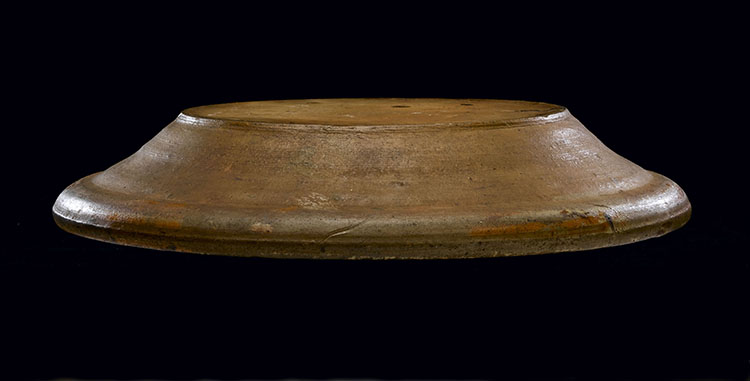
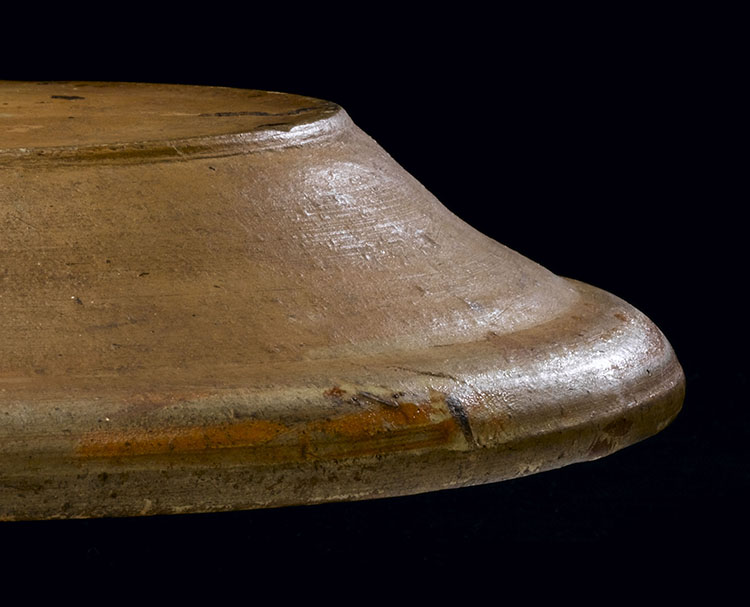
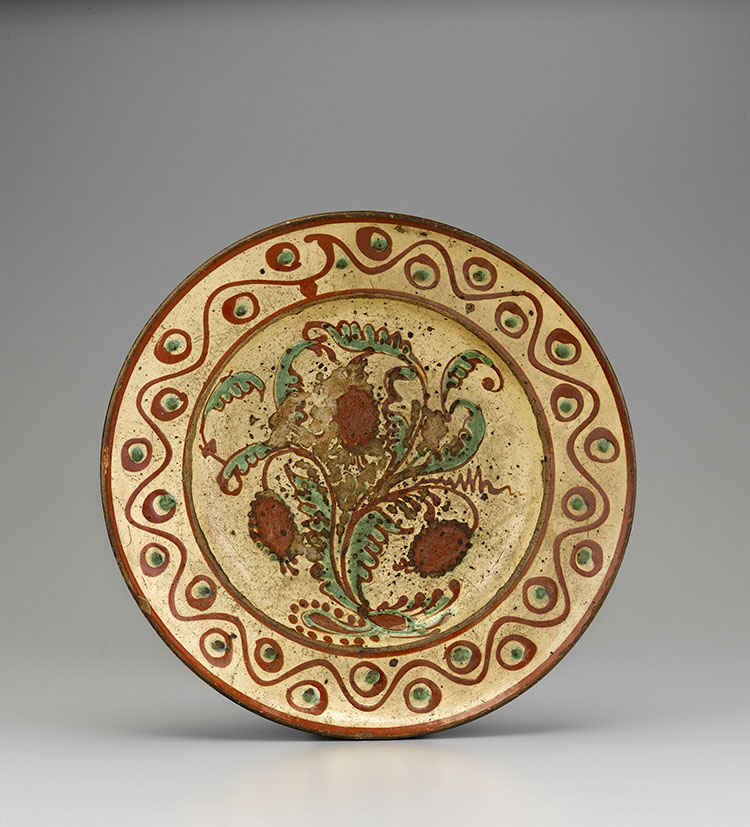
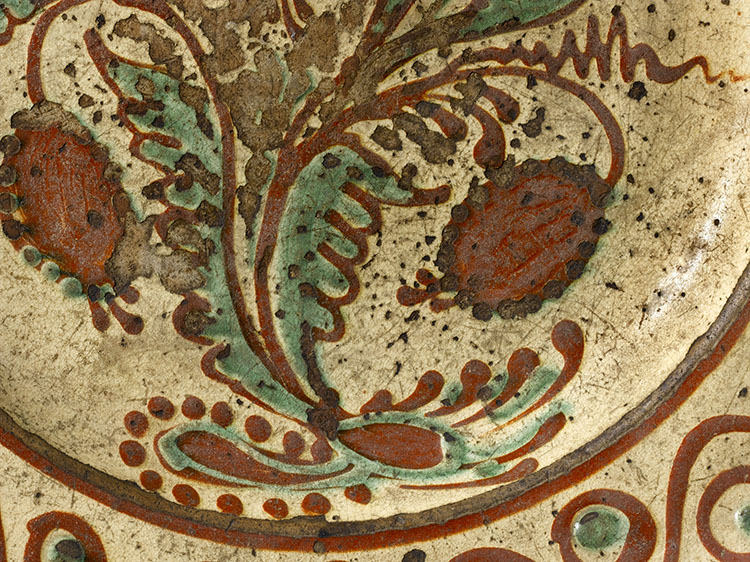
DESCRIPTION: Slip Decorated, lead glazed earthenware dish; marley or rim decorated with undulating line of red slip with green dotted red circles in each curve; cavetto design consists of jewelled fruits suspended from flowing foliage; the fruits are thought to be pomegranates. Base slip is white (cream colored); decorative elements are red slip (colored with iron oxide) and green (colored with copper oxide). The shape of the underside of the rim of the dish is rolled under as is commonly seen of dishes made in Wachovia in this period. The underside is unglazed.

DECORATION: The undulating line and dot decoration on the marely of this dish is reminiscent of decoration on Mocha-ware that was popular at the same time that the Rudolph Christ shop was in operation.

SIGNIFICANCE OF DECORATION: Motifs in Moravian slipware have theological underpinnings. At a meeting of the Pilgrim Congregation of London in 1749, Zinzendorf cut open a pomegranate to show how it is an allegory for the beauty of the bride of Christ filled with the blood of Christ. Leonardo da Vinci and Sandro Boticelli used similar metaphorical imagery in their religious paintings. Moravian potters often represented pomegranates partially cut open with crosshatched or parallel lines representing the center and, occasionally, jeweled dots representing seeds on the outside.

ARTIST: Rudolph Christ was born in 1750 in Laufen, Duchy of Württemberg (Herzogtum Württemberg) and died July 26, 1833 in Salem, North Carolina. He was the second master potter in Wachovia, having been trained by the progenitor of the Wachovia earthenware tradition, Gottfried Aust. Although his slip decorated wares are reminiscent of the work of Aust, Rudolph Christ can be credited for the successful production and marketing of press molded figural wares during his tenure as master of the pottery at Salem(1789–1821). Rudolph Christ apprenticed under Gottfried Aust in Salem, North Carolina. He established his own pottery in Bethabara in 1786 and worked there until 1789. He succeeded Aust as master potter in Salem from 1789 to 1821. (Ceramics in America 2009) The production of press-molded wares also continued through the tenure of John Holland, who apprenticed under Rudolph Christ and as noted in Moravian records, inherited molds used in Christ’s shop. Rudolph Christ retired in 1821 and John Holland took over as Salem’s third master potter. Although the pottery ceased to operate as a congregational business in 1829, production of press-molded wares continued in the shop of Holland and another Salem, potter, Heinrich Schaffner until at least the middle of the nineteenth century.
For additional biographical information about Rudolph Christ and Gottfried Aust, please see CERAMICS IN AMERICA, 2009, ed. by Robert Hunter and Luke Beckerdite.
History
Rudolph Christ apprenticed under Gottfried Aust in Salem. He established his own pottery in Bethabara in 1786 and worked there until 1789. He succeeded Aust as master potter in Salem from 1789 to 1821. (Ceramics in America 2010)
Artist Biography
MAKER: Rudolph Christ (1750-1833), the son of Rudolph Christ and Anna Wolf, was born in Lauten, Wurtemberg, Germany. He arrived in Bethabara in 1764 at the age of fourteen. In 1766, he apprenticed to Gottfried Aust, whose shop was in Salem, with whom he had a turbulent relationship. In August, 1770, the Elders Conference noted in its minutes that “Aust and his apprentice Christ have separated again” and Christ had written a letter to Brother Marshall begging to be released from his master and to be transferred to another settlement. After repeated requests, Christ was finally released in 1771, and he became the apprentice to the Salem gunmaker. Due to the lack of business at the gunshop, however, Christ returned to Aust’s pottery in 1772. He was freed of his apprenticeship in either 1773 or 1774, yet he remained in the pottery as a journeyman. Christ learned the art of making Queensware, while Aust continued to produce only earthenware. The young man listed this difference of materials as one of the many reasons he should be permitted to establish his own pottery. Time after time his attempts were thwarted by the Elders Conference, who clearly thought of him as a troublemaker. In 1780, the Elders Conference suggested that he marry Elizabeth Oesterlein, who became his first wife. This marriage gave him further reason to desire to be on his own, and finally in 1785, he received permission to set up his own business in Bethabara. He produced simpler varieties of Queensware such as moulded plates and Oriental form bowls. Many works had a mottled glaze. He had his own apprentices some of whom were Jacob Myer, David Baumgarten, and John Butner, who became master of the Bethabara pottery when Christ returned to Salem. Christ experimented with tin-enameled or faience pottery and grey salt-glazed stoneware which was popular in Pennsylvania. Christ was the master in Bethabara from 1786 to 1789, and then he became the master of Salem from 1789 to 1821.