
Sampler
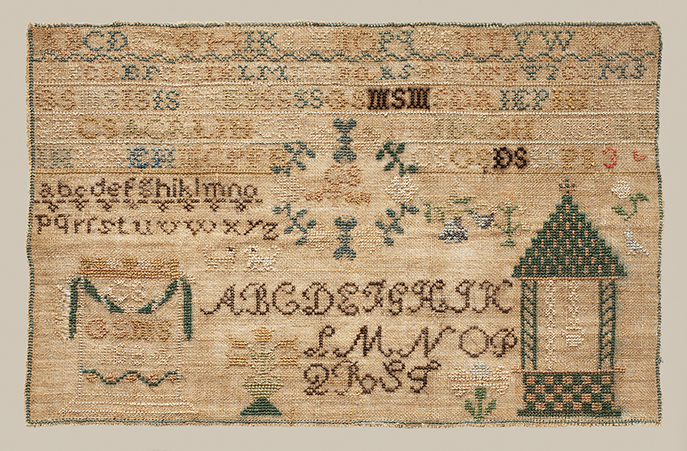
LABEL NOTES: Christina Spach (1792-1863) stitched this sampler when she was twelve years old. She included her
initials in the center wreath, and those of her parents in the plinth. The wreath, plinth, and well are common motifs on Salem samplers as well as the Moravian seminaries in Pennsylvania. The exchange of teachers between Moravian communities accounts for motifs appearing on samplers from both regions.
The well is adapted from the New Testament story of the woman at the well. An ancient symbol of victory, the wreath also symbolized the victory of Christian redemption. Moravians considered their boarding schools an opportunity to “plant the good seed” of Christian theology. Embroidery patterns with symbolic biblical meaning were one of the methods used to accomplish this goal.
Sampler (1804)
Christina Spach
Silk on linen
Salem, North Carolina
Old Salem Museums & Gardens
Gift of Mary Patterson Fisher
The well is adapted from the New Testament story of the woman at the well. An ancient symbol of victory, the wreath also symbolized the victory of Christian redemption. Moravians considered their boarding schools an opportunity to “plant the good seed” of Christian theology. Embroidery patterns with symbolic biblical meaning were one of the methods used to accomplish this goal.
“This sampler was done by Christina Spach (later the wife of John Vogler) when she was twelve years old. The sampler exhibits several of the motifs that were poplular in Salem samplers in the early nineteenth century. The central ring of flowers encircling initials or a date, the water well, and the rectangular vertical pedestal bearing the initials of the grils’ parents are sometimes used in combination with flowers and trees and flower baskets.” (Welshimer in Bivins and Welshimer, MORAVIAN DECORATIVE ARTS IN NORTH CAROLINA, 1981, p.59).