

Sampler

Artist/Maker
Hill, Maria
Place Made
Salem North Carolina United States of America
Date Made
1810
Medium
silk on linen
Dimensions
HOA 21; WOA 21 3/4
Accession Number
2616
Description
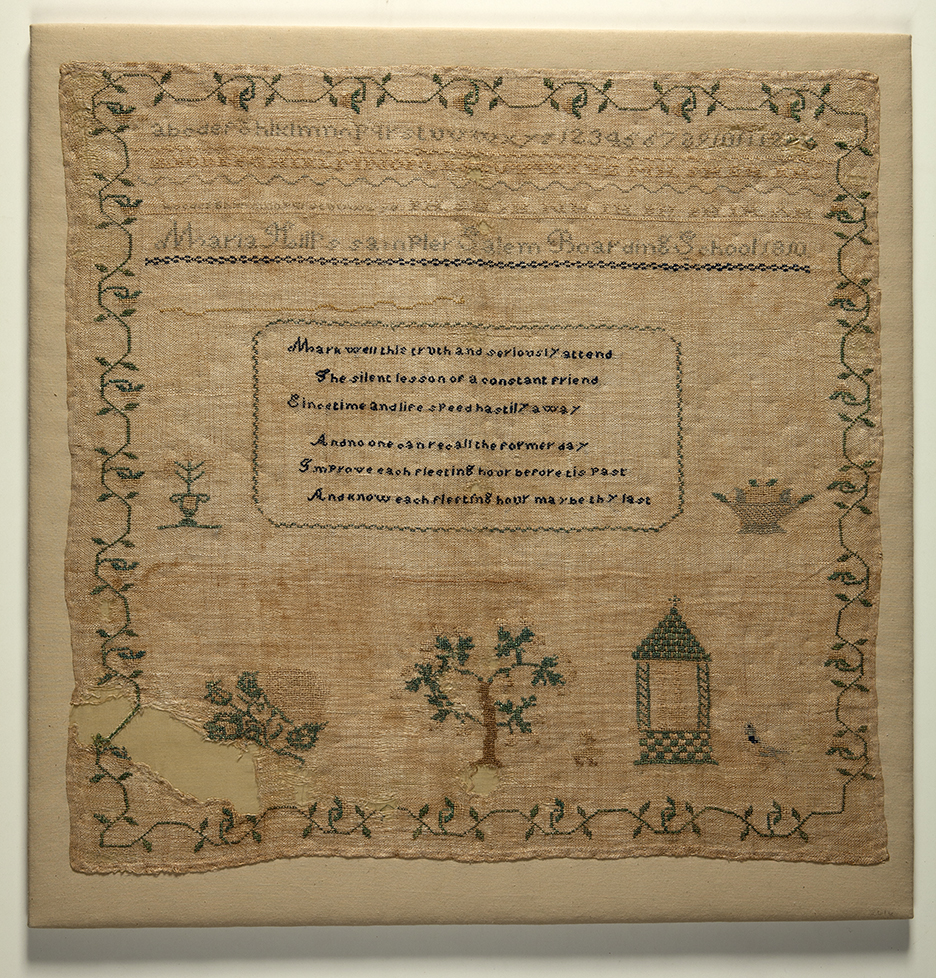
DESCRIPTION: Silk on linen sampler; floral vine surrounds the whole; three lines of the alphabet at top; below alphabet is cross stitched: “Maria Hill’s sampler Salem Boarding School 1810”; in the center is a verse enclosed in border: “Mark well this truth and seriously attend/ The silent lesson of a constant friend/ since time and life speed hastily away/ And no one can recall the former day/ Improve each fleeting hour before tis past/ And know each fleeting hour may be thy last”; motifs include wellhouse, tree, flower, birds.

Included in the exhibition, Specimens of Taste and Industry: The Needlework of Salem, 1780-1860.

LABEL NOTES:
Sampler (1810)
Maria Hill
Salem, North Carolina
Silk on linen
Old Salem Museums & Gardens
Gift of William G. Head

Maria Hill (1797-1859) attended the Salem Girls’ Boarding School between 1808 and 1810. She was the daughter of Thomas and Susanna Hill who lived near Wilmington, North Carolina. Correspondence between her father and the Inspector suggests that she may not have been the strongest student academically, but that “her conduct is agreeable” and she is “attentive % assiduous & this makes it up.”

History
HISTORY: Maria Hill (1799-1837) was the daughter of Thomas (1770-1818) and Susanna (Mabson) Hill, who lived at Hyrneham Plantation on the Cape Fear River near Wilmington and later at Hailbron Plantation, located near Pittsboro in Chatham County, North Carolina. Through her grandmother Margaret (Moore) Hill, she was closely related to the prominent Moore family of Orton Plantation. In 1807, her father advertised Hyrneham as a 3000-acre plantation with a two-story brick house and multiple outbuildings.

Maria Hill was born on May 22, 1799, and attended the Salem Girls Boarding School between October 12, 1808 and October 10, 1810. Correspondence between her father and the Inspector, Abraham Steiner, suggests that she may not have been the strongest student academically, but that “her conduct is agreeable” and she is “attentive & assiduous & this makes it up.” In 1823, she married William H. Hardin (1797-1885) of Raleigh. Hardin was a teacher who in the 1830s founded the Kelvin School, a private boarding school for girls near Pittsboro.
Credit Line
Gift of William G. Head