Sampler
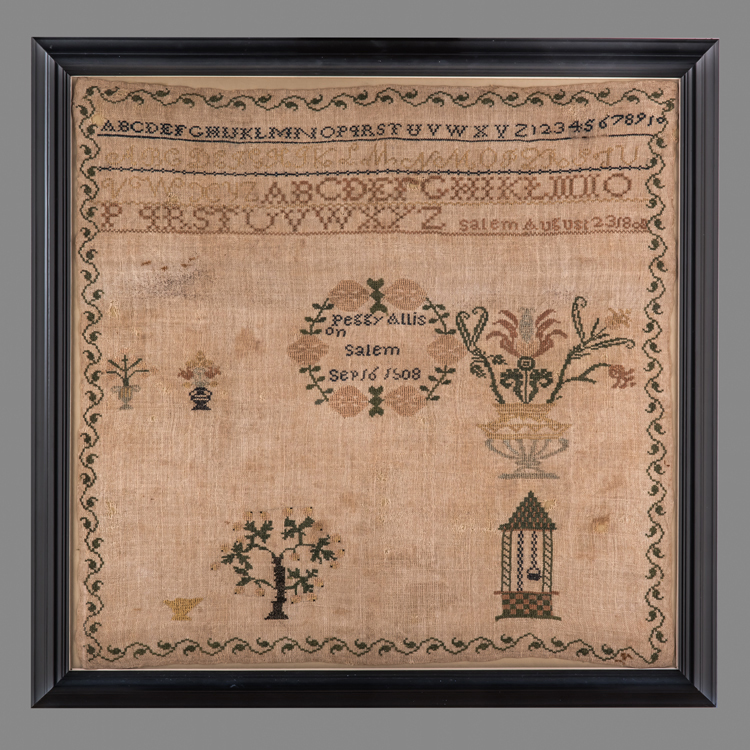
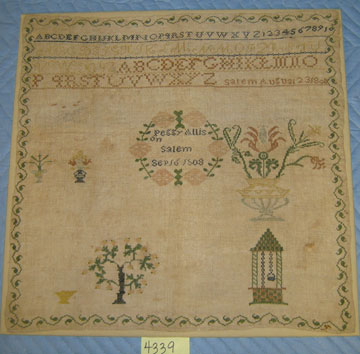
DESCRIPTION: Unframed (at acquisition) sampler; silk on linen; green vine border; 4 lines of alphabet in various sizes and colors (dark blue, gold, brown); “Salem August 23 1808” at end of the last line of letters; beneath alphabet in center is a wreath of pink flowers with green stems and leaves surrounding dark blue inscription “Peggy Allis/on/Salem/Sep 16 1808”. To left of wreath are two small vases with flowers; to right of wreath is a large vase with flowers; in lower left corner is gold pot; at bottom to left of center is a tree with black trunk and yellow and pink flowers; in right corner is pink and green well with navy blue bucket and chain.
Peggy Allison’s Moravian Sampler and its Influence on Bethel Group Samplers
At age fourteen Margaret Malvinia “Peggy” Allison left York District, South Carolina, in 1808 with her sister Adeline to attend Salem Girl’s Boarding School in Salem, North Carolina. When Peggy left Salem in 1810, she returned to Yorkville with a needlework sampler and familiarity with the patterns and motifs preferred by her Moravian needlework teachers. Evidence suggests that after her return to South Carolina, she eventually instructed girls from local academies associated with or sponsored by Bethel Presbyterian Church in the York District. The related samplers are referred to as the Bethel Group samplers.
The sampler Peggy made at Salem includes alphabets and several motifs such a well, wreath cartouche, oak tree, and stylistic vases of flowers often seen on Moravian samplers. The transfer of these designs to the York County sampler tradition is best illustrated in Jane Meek Adams’s sampler.
Jane Meek Adams (1817-1902) did not attend Salem Girls’ Boarding School . According to family tradition she attended the Yorkville Female Academy. Yet the sampler she made in 1828 incorporates several of the motifs used by Peggy Allison two decades earlier: the well, wreath cartouche, oak tree, vases of flowers and baskets.
Analysis of Jane’s sampler suggests that she received careful instruction, that she had access to German patterns, and that she likely consulted the Allison sampler as an example.
Jane Meek Adams remained in the Bethel Presbyterian Church community making it likely that her sampler, modeled from Peggy Allison’s and designed with German patterns from Salem, set an example for other Bethel Group needlework. Her choice of a decorative border, the wreath cartouche, baskets and the use of particular geometric bands separating the alphabets appeared on Bethel Group samplers through 1848, extending the influence begun by Peggy Allison over three generations of schoolgirls.
(“Samplers of the Carolina Piedmont: The Presbyterian Connection and the Bethel Group” by Patricia V. Veasey – See more at: http://www.mesdajournal.org/online-issues/#sthash.6Dj43PjI.dpuf).