Shop Sign
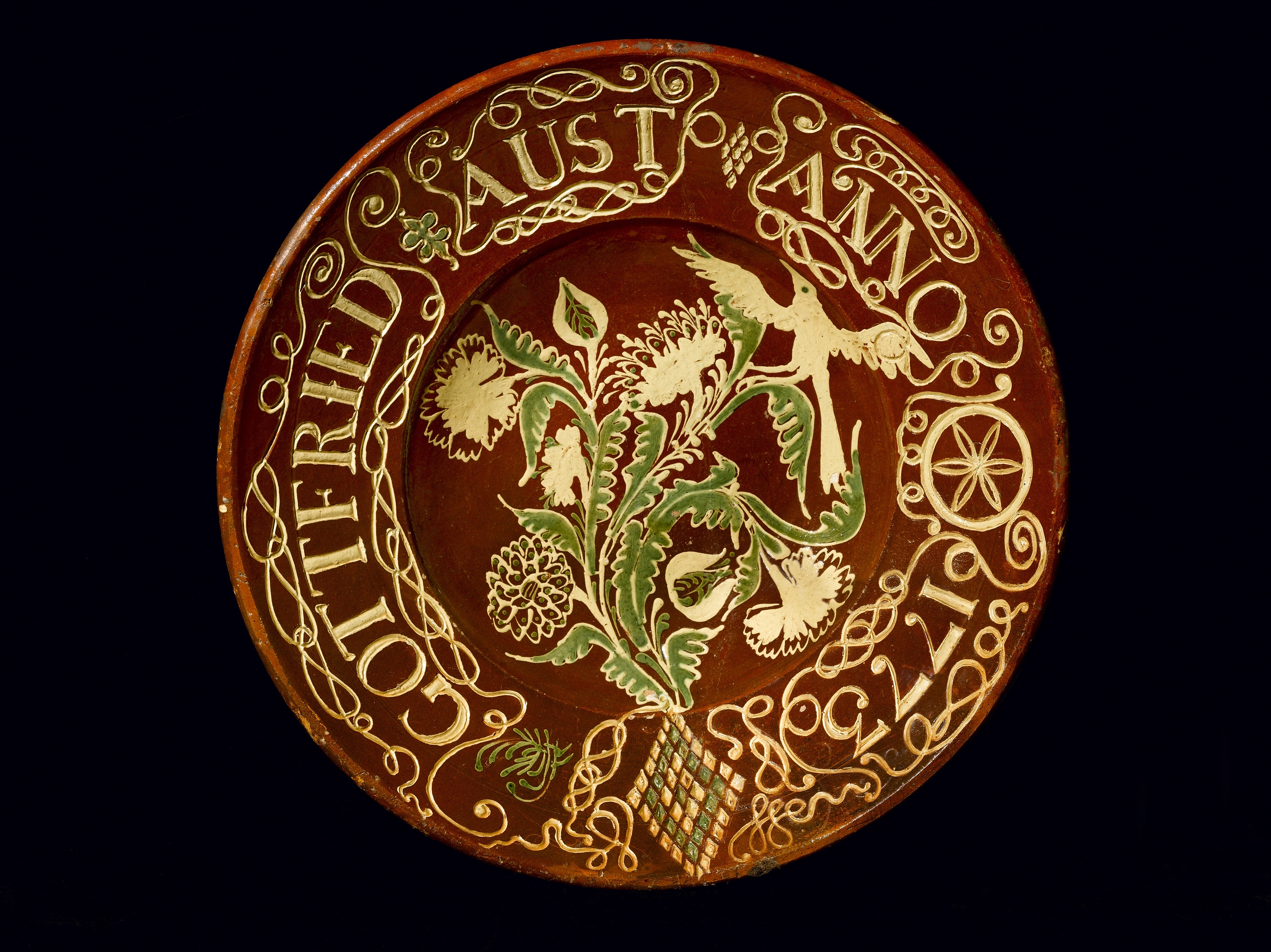
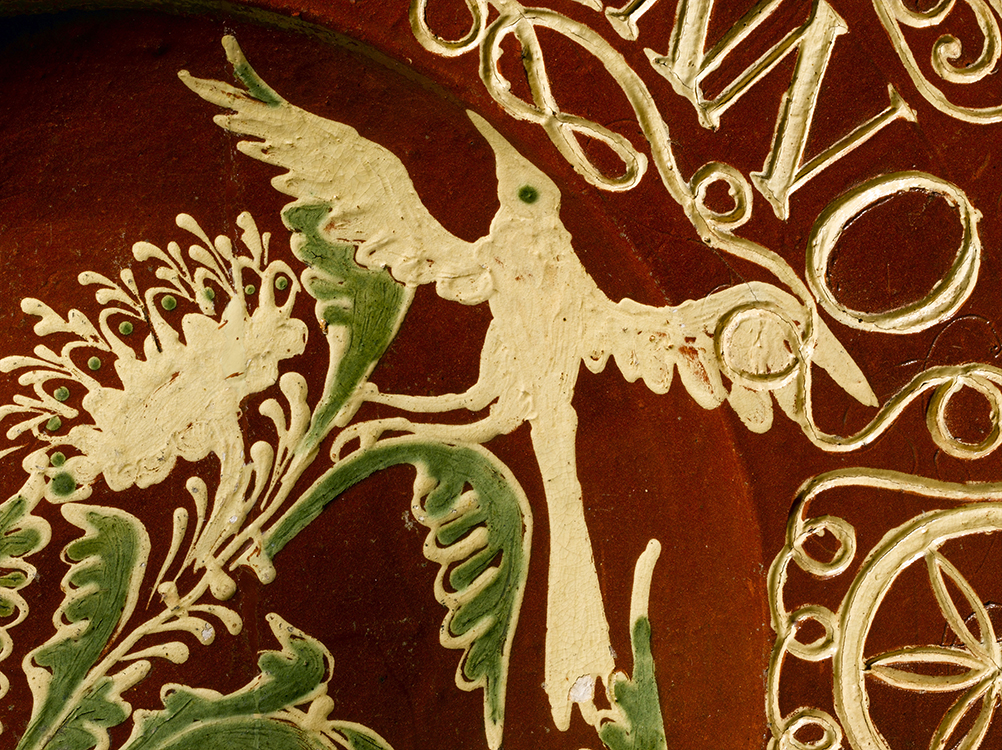
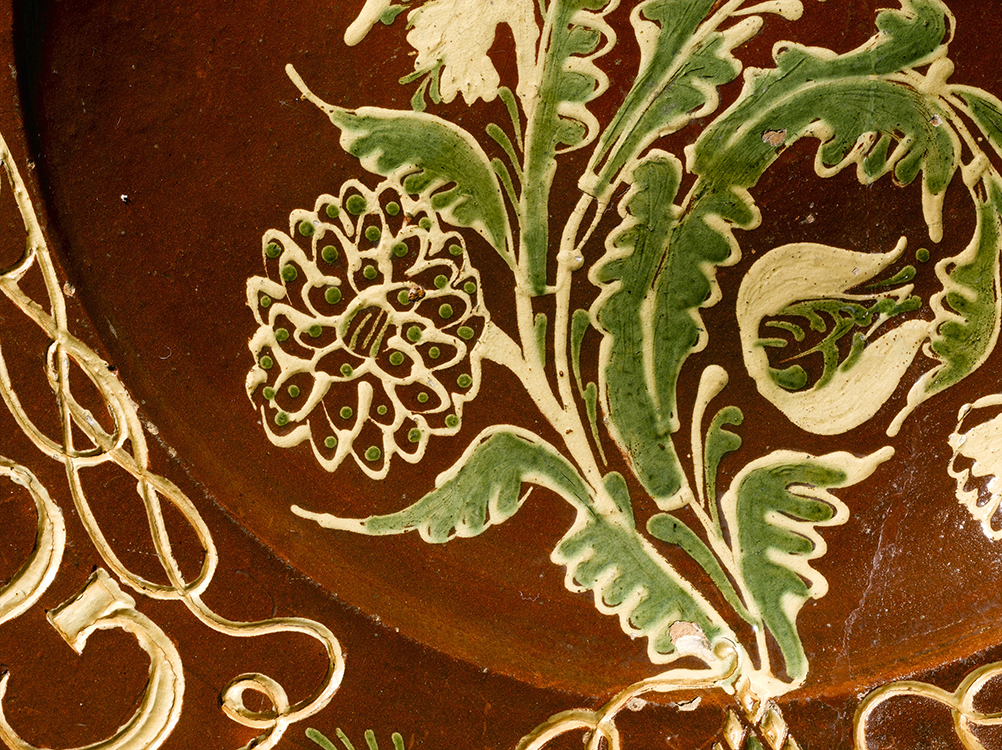
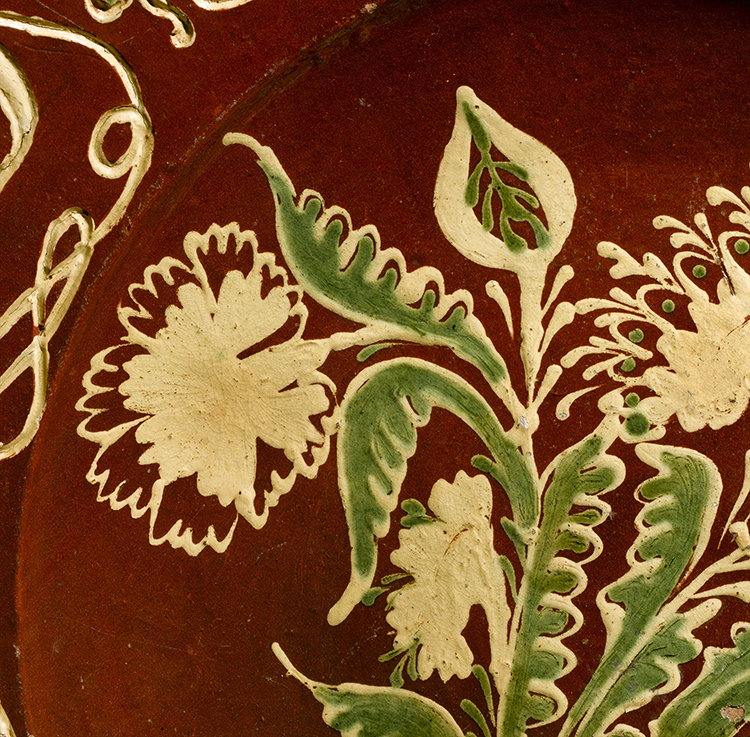
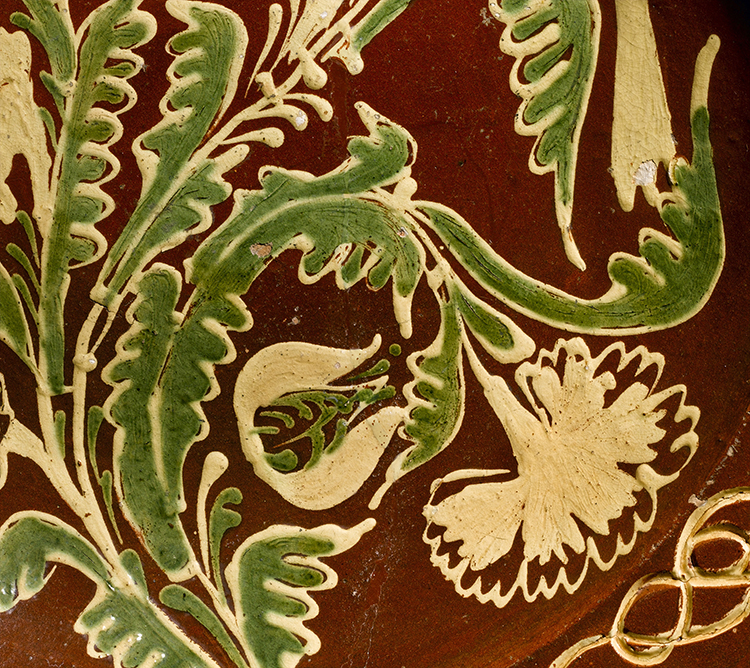
Aust’s shop sign attests to the cosmopolitan nature of Moravian ceramics. The cavetto decoration shares details with enameling on a French Faience dish from the late seventeenth century (see Ceramics is America 2009: 19) including carnations, foliage, and a prominent bird. Motifs found on this class of Nevers ware were derived largely from Chinese, Persian, and Iznik ceramics. Eastern motifs occur in a structured composition reminiscent of flower paintings and prints. Aust may never have seen any Iznik pottery, but he probably came in contact with European ceramics that had been influenced by Iznik designs.
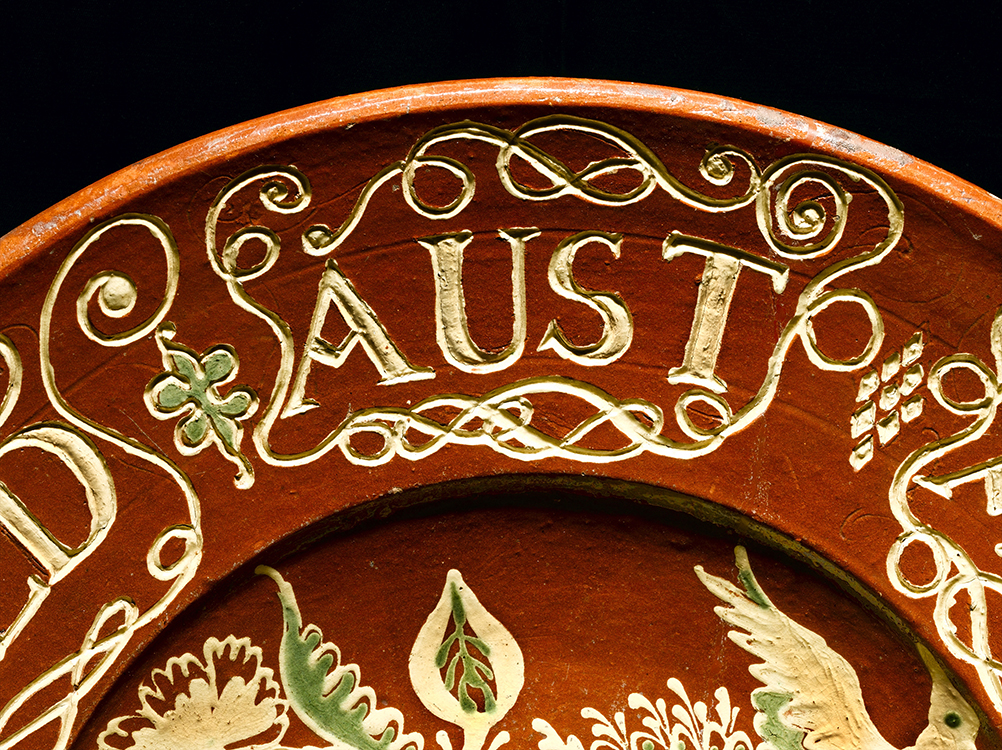
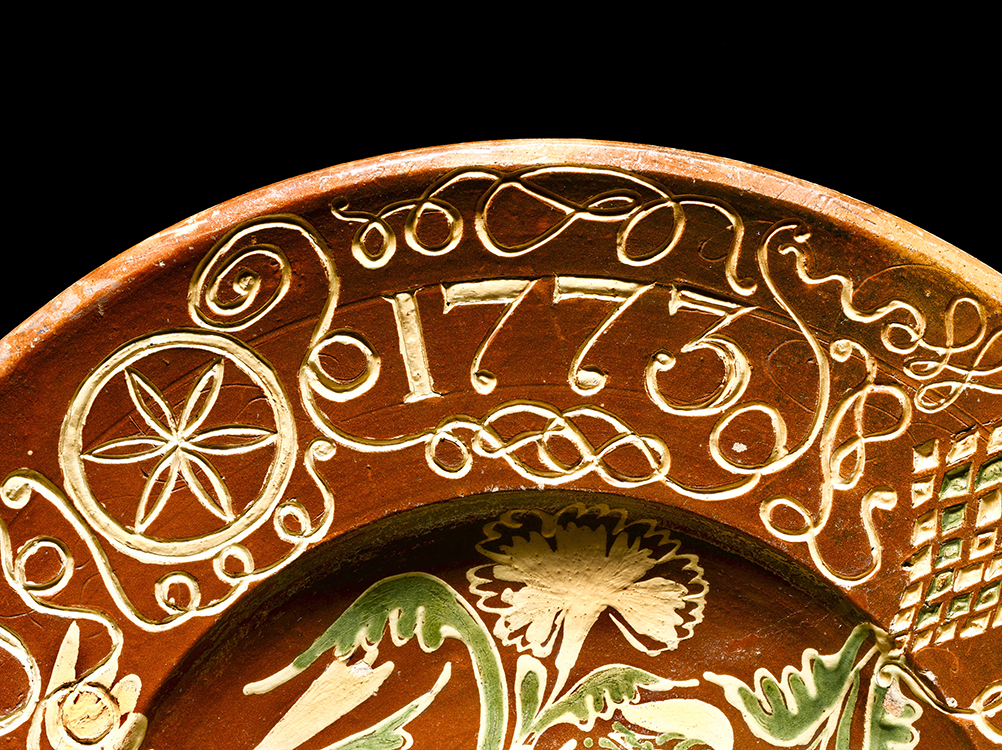
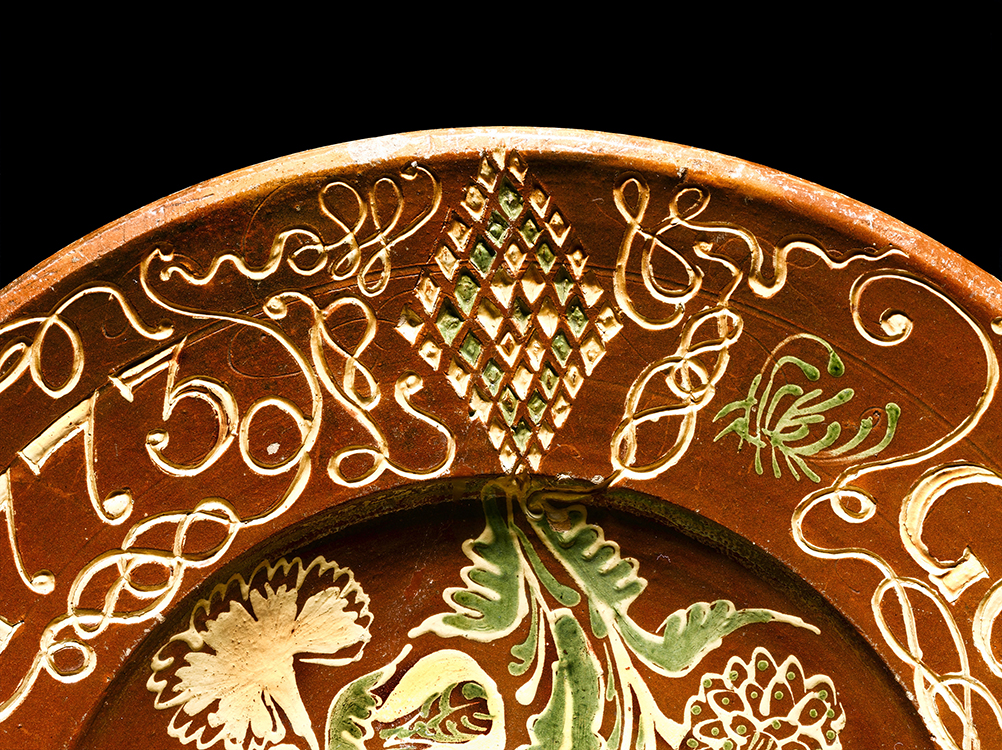
Master potter Gottfried Aust made this shop sign in response to a church board directive “to place proper signs at the houses of the tradesmen, store and tavern in order that strangers could find them easily….” and the sign is marked with the inscription, “GOTTFRIED AUST ANNO 1773” around the marly.
Gottfried Aust (1722-1788) arrived in Bethabara in 1755 and immediately sought local stores of clay and flint for use in his pottery. By the spring of 1756 he had conducted firing experiments on these materials, and in August he built a larger kiln in which he fired earthenware. Aust stayed in Bethabara until 1771, where upon he moved to the Moravians’ newly built town of Salem and served as master of the pottery there until his death in 1788.
Flowers have long been used to represent the transience of life in the visual arts. Dutch artist Hendrick Goltzius (1558–1617) alluded to the inevitability of death when he included a skull, hourglass, and tulip in his 1614 pen and ink drawing of a young man. The inscription under the hourglass reads: “Quis evadet/ Nemo (Who escapes/ None).” Art historians traditionally have viewed the great flower paintings of the seventeenth century from a similar perspective. Both the flowers and the container holding them are fragile, signifying the ephemeral nature of worldly things. Within the Moravian community, slipware dishes carried the same connotation. (Art in Clay Gallery Guide)
The most frequently depicted flowers on Moravian dishes are anemones, which often appear in conjunction with lilies of the valley. Christians have long associated anemones with Jesus’ sacrifice, believing them to be the flowers that sprung from the ground as the blood flowed from his wounds. As the flowers in the foreground of an anonymous Crucifixion painting from Herrnhut suggest, anemones held special significance for Moravians, who focused on Christ’s blood and wounds more than other Protestant sects. Compelling evidence for the symbolic importance of anemones in Moravian art can be found in artist John Valentine Haidt’s Cornelius Forseeing his Christianity. The painting, which was probably owned by one of the Moravian congregations in North Carolina, depicts the Roman centurion Cornelius, who is considered to be the first Gentile converted to Christianity, and Mary holding the Christ child. Below the hem of Mary’s robe are two white anemones draped over a book that probably represents the New Testament. In this context, the flowers represent the death of Christ to come rather than his crucifixion. Aust and his successors used strikingly similar floral compositions on their slipware dishes. The lilies on Moravian slipware may have been visual analogues for the marriage metaphor that was pervasive in early Moravian theology. The memoir of single sister Anna Rosina Anders (1727–1803) describes the final moments of her life, when she “went gently and happy over into the arms of her beloved Bridegroom.” As a flower that blooms early in the spring, the lily symbolizes both the advent of Christ and each believer’s relationship to him. In the rustic mysticism of Jacob Boehme, who influenced Zinzendorf and other pietist theologians, lilies are also a symbol of God and the regenerated spirit of man. Other motifs in Moravian slipware have similar theological underpinnings. At a meeting of the Pilgrim Congregation of London in 1749, Zinzendorf cut open a pomegranate to show how it is an allegory for the beauty of the bride of Christ filled with the blood of Christ. Leonardo da Vinci and Sandro Boticelli used similar metaphorical imagery in their religious paintings. Moravian potters often represented pomegranates partially cut open with crosshatched or parallel lines representing the center and, occasionally, jeweled dots representing seeds on the outside. Scholars will never be able to fully interpret the designs on Moravian slipware, because the meaning of motifs varied from person to person. An unusual slipware dish depicting turtles and fish illustrates the point. To some observers its composition may have been interpreted literally.
Moravians, however, may have seen something entirely different. To them, the pond was a metaphor for Christ’s side wound. Believers were described as fish in the “sea Wound” of Christ, “swimming in the bed of blood.” (Art in Clay Gallery Guide)
See Also “Ceramics in America” 2009