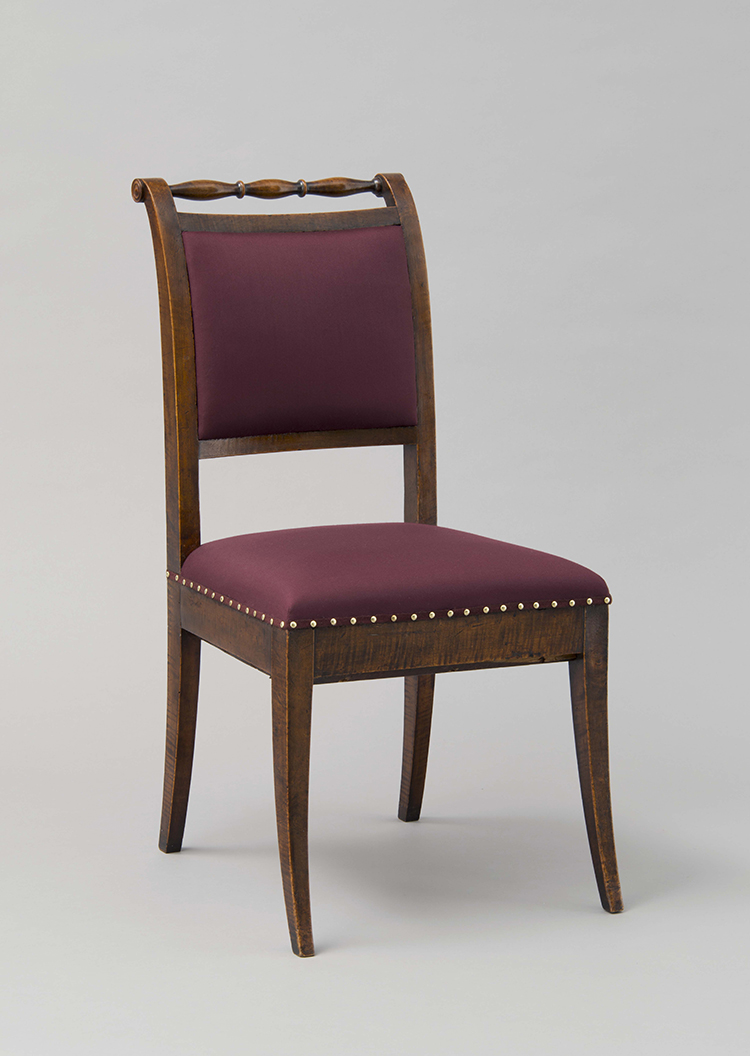
Side Chair
Artist/Maker
Petersen, Karsten (possibly)
Place Made
Salem, North Carolina
Date Made
1815-1830 C.
Medium
curly maple and poplar
Dimensions
HOA 35 3/8; WOA 18 1/2; DOA 26 (overall from tip of splayed feet to outermost edge of scrolled crest rail)
Accession Number
2837.3
Description
Side chair with scrolled back supports; back has two slats mortised into stiles between which is mounted an upholstered cushion; a horizontal turned spindle forms the crest rail; seat has solid poplar board screwed to the bottom of deep seat rails to support upholstered seat; slightly tapered saber legs are screwed into side rails of seat.
WOODS: Curly maple primary wood with poplar used as secondary wood; chair is a rare example of veneered Moravian furniture. The seat rails are veneered with curly maple over poplar.
History
LABEL NOTES: This chair is one of several Salem pieces that was executed in the Biedermeier style. This term “Biedermeier” has been used to describe the period of cultural development in Germany, Austria, and Denmark following the Napoleonic wars which ended in 1815. Biedermeier furniture generally followed the lines of what has Become known as the French Empire, but achieved its elegant look through simpler lines and less ornamentation.
Upholstered furniture is extremely rare in the pre-civil war backcountry. Years of MESDA field research have uncovered almost no upholstered furniture in the backcountry other than a significant body of upholstered North Carolina Moravian pieces such as this chair (BLR).
This chair is signed and descended in the Petersen family.
Artist Biography
ARTIST BIO: Karsten Petersen was born in Wichkrug by Flensburg, Schelswig-Holstein, Prussia on April 21, 1776. Although little is known of his background or training, evidence suggests that he may have lived in Denmark for several years. In 1806, he immigrated to Salem from Gnadau via Bethlehem, Pennsylvania. After a brief period in Salem during which Petersen worked in the Single Brothers’ joiner shop and studied English, he and Johann Christian Burkhardt traveled to Georgia to work as craftsmen among the Creek Indians on the Flint River. Petersen and Burkhardt returned to Salem in 1813 and Petersen set up first a turner shop and later a cabinetmaking shop on what had formerly been the Brother’ slaughter house lot. In 1816, Petersen married Suzanna Praezel. They had five children. Their two sons, William and Edward trained in their father’s shop and took the shop over when Petersen died in 1858.
Credit Line
Gift of William Boyd