Description
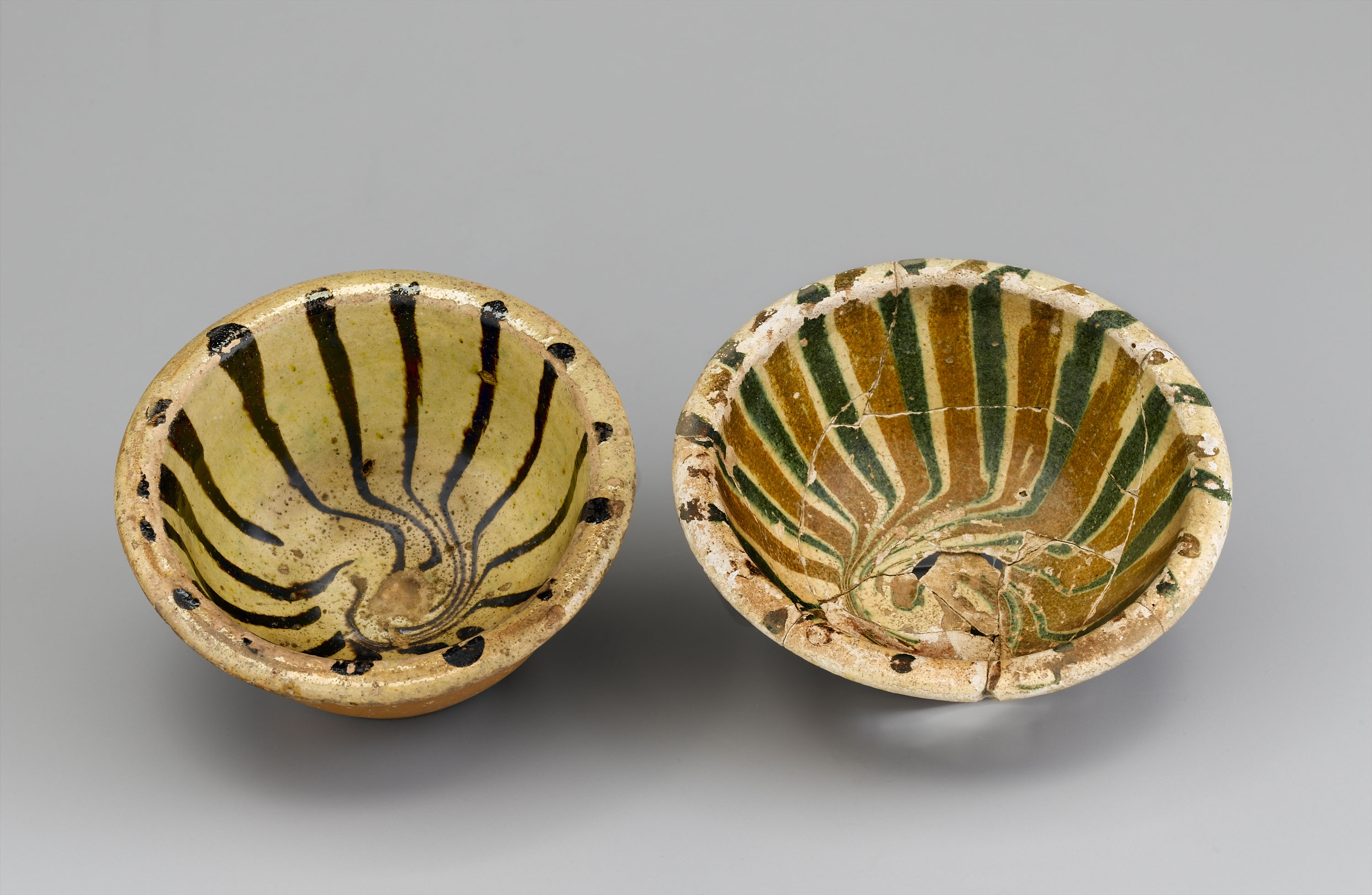
DESCRIPTION: Swirled slip decorated earthenware bowl; interior slip is white (looks cream colored with glaze) with manganese applied in lines around the interior of the bowl and swirled in the bottom center; exterior is unglazed; bowl as small lip; bulbous shape tapers gently toward the foot and then more drastically at the foot.
History
HISTORY: The only extant above ground example of a swirled this bowl, this piece was made in the shop of Rudolph Christ either in Bethabara when he was master there (1786-1789) or Salem when he was master there (1789-1821). Fragments of unglazed waster swirled slip bowls (albeit with multiple colors ( probably copper and iron) comprising the slip) have been found in association with both Christ’s pottery site at Bethabara (Lot B-20) and Salem (Lot S-39).
Critically important to our understanding of this bowl is the fact that in both Bethabara and in Salem the enslaved potter (who later bought his freedom), Peter Oliver, worked with Christ in his pottery. With training from Christ, Peter Oliver became a skilled potter. The January 2, 1789, Elders Conference minutes describing what Rudolph Christ would leave behind when he left Bethabara for Salem after the death of Gottfried Aust note: “It would be best if his successor in Bethabara [Gottlieb Krause] would buy him[ Peter Oliver]. In view of the efforts of Br. Christ with the Negro to bring him thus far in the trade it is fair that he should receive a higher price for him.”
Peter Oliver and Krause did not get along, however, and in 1795 Peter Oliver requested he be allowed to return to Salem to work once again with Rudolph Christ. The Church agreed that Oliver could return to Salem to work in Christ’s pottery. In other words, Oliver, a trained potter, may have been working in the Bethabara or Salem pottery when this bowl was made. His hands could easily have formed its walls as the potter’s wheel turned or held the cup from which the rich manganese tinted slip trickled and was swirled to create the design we find so appealing.
Artist Biography
MAKER: Rudolph Christ (1750-1833), the son of Rudolph Christ and Anna Wolf, was born in Lauten, Wurtemberg, Germany. He arrived in Bethabara in 1764 at the age of fourteen. In 1766, he apprenticed to Gottfried Aust, whose shop was in Salem, with whom he had a turbulent relationship. In August, 1770, the Elders Conference noted in its minutes that “Aust and his apprentice Christ have separated again” and Christ had written a letter to Brother Marshall begging to be released from his master and to be transferred to another settlement. After repeated requests, Christ was finally released in 1771, and he became the apprentice to the Salem gunmaker. Due to the lack of business at the gunshop, however, Christ returned to Aust’s pottery in 1772. He was freed of his apprenticeship in either 1773 or 1774, yet he remained in the pottery as a journeyman. Christ learned the art of making Queensware, while Aust continued to produce only earthenware. The young man listed this difference of materials as one of the many reasons he should be permitted to establish his own pottery. Time after time his attempts were thwarted by the Elders Conference, who clearly thought of him as a troublemaker. In 1780, the Elders Conference suggested that he marry Elizabeth Oesterlein, who became his first wife. This marriage gave him further reason to desire to be on his own, and finally in 1785, he received permission to set up his own business in Bethabara. He produced simpler varieties of Queensware such as moulded plates and Oriental form bowls. Many works had a mottled glaze. He had his own apprentices some of whom were Jacob Myer, David Baumgarten, and John Butner, who became master of the Bethabara pottery when Christ returned to Salem. Christ experimented with tin-enameled or faience pottery and grey salt-glazed stoneware which was popular in Pennsylvania. Christ was the master in Bethabara from 1786 to 1789, and then he became the master of Salem from 1789 to 1821.