Taufschein for Anna Susanna Schultz
Framed; HOA 18; WOA 14 7/8; DOA 1
Inscription:
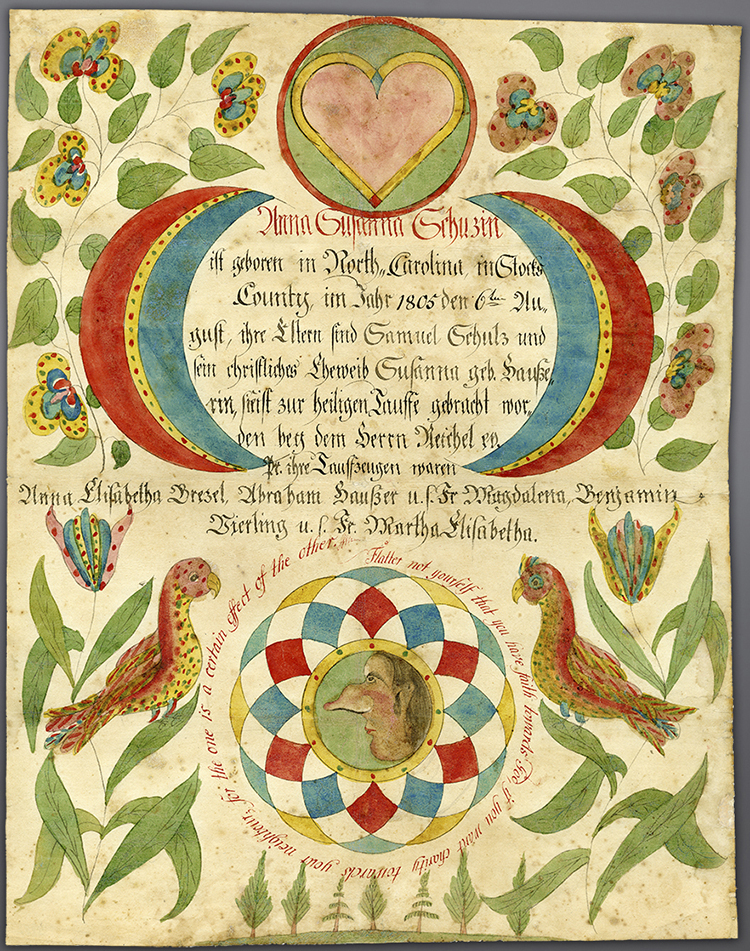
Anna Susanna Schuzin / Ist geboren in North Carolina, in Stocks / County im Jahr 1805 den 6ten Au / gust, ihre Eltern sind Samuel Schulz und / sein christliches Eheweib Susanna geb. Hause / rin, sie ist zur heligen Tauffe gebracht wor / den bey dem Herrn Reichel ev. / Pr. Ihre Taufzeugen waren / Anna Elizabetha Bresel, Abraham Hauser, u. s. Fr Magdalena Benjamin / Vierling u. s. Fr. Martha Elizabetha.
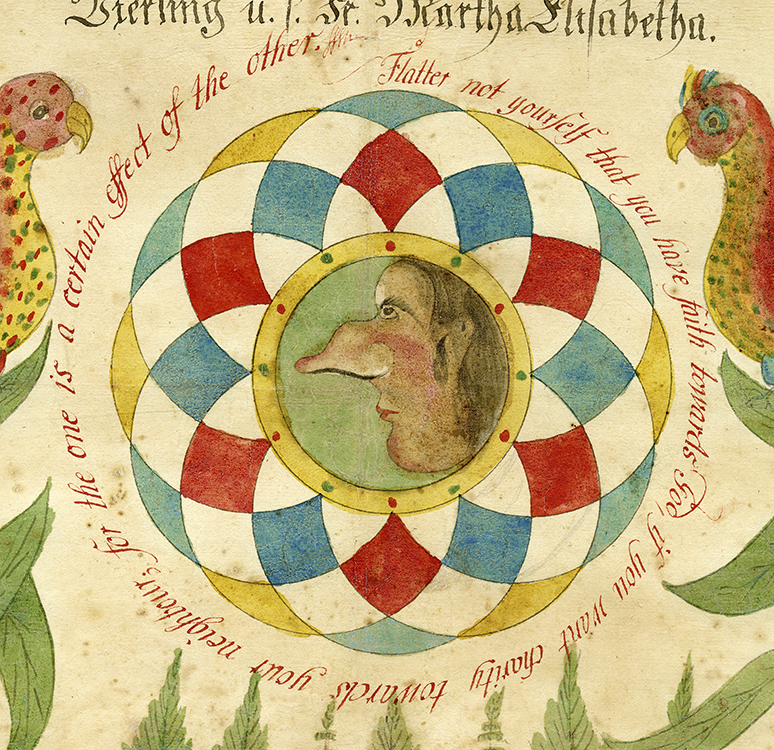
Translation: Anna Susanna Schuz / Was born in North Carolina in Stokes / County in the year 1805 the 6th Au / gust, her parents are Samuel Schulz and / his Christian wife Susanna nee Hauser, / she was brought to holy Baptism / by Mr. Reichel ev. / minister. Her sponsors were / Anna Elizabeth Brezel (Praezel), Abraham Hauser and his wife Magdalena, Benjamin / Vierling and his wife Martha Elizabeth. / Flatter not yourself that you have faith towards God if you want Charity towards your neighbor for the one is a certain effect of the other. [A paraphrase from Francis Quarles’s 1640 Enchiridion, Book II, Chapter XI, “Flatter not thy selfe in thy faith to God, if thou wantest charity for thy neighbour; and thinke not thou hast charity for thy neighbour, if thou wantest faith to God.” ]
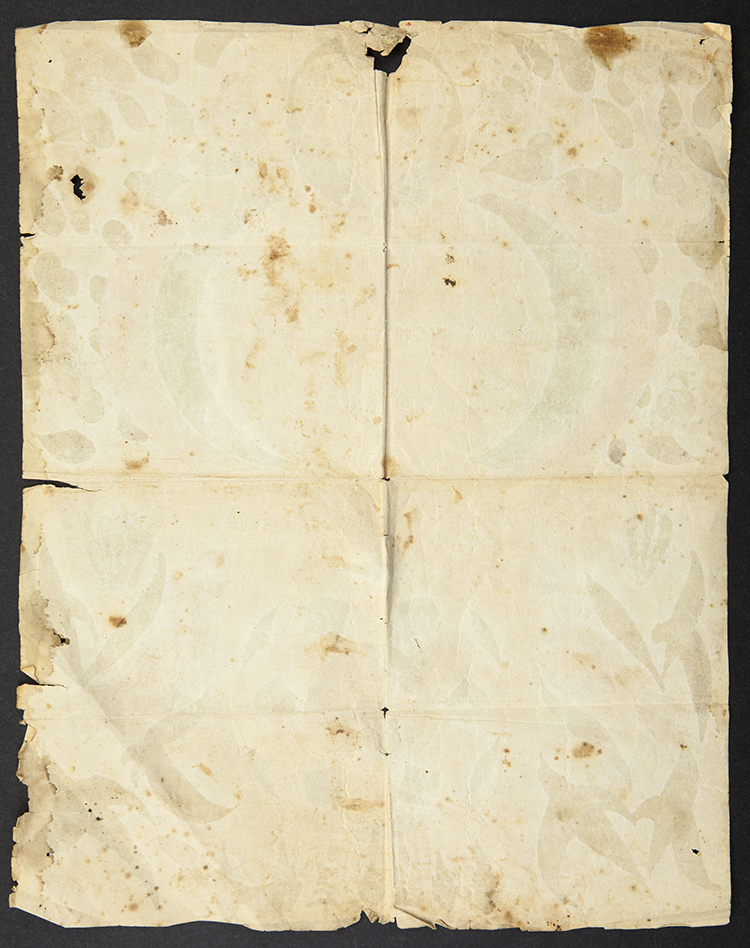
Artist/Maker: Ehre Vater Artist (working 1782-1828). This itinerant artist was given the working name of the Ehre Vater Artist in 1961 by Donald Shelley in his publication Fraktur Writings or Illuminated Manuscripts of the Pennsylvania Germans (1961: Pennsylvania German Folklore Society). The name derives from the artist’s frequent use of the bold masthead “Ehre Vater und Mutter” (Honor Father and Mother). Scholars John Bivins and Frederick Weiser have suggested that the artist may have been an itinerant parochial schoolmaster of the Lutheran or Reformed faith. The artist’s attributed works cover a wide geographic range from the “Dutch Fork” region of South Carolina through North Carolina, Virginia and Pennsylvania. The largest concentrations of works appear in the Germanic communities of Pennsylvania and the Moravian settlements of the Wachovia Tract in North Carolina, where most of the known works were created for families in the Friedberg and Friedland communities. The relative uniformity of the North Carolina works suggests that they may have been produced within in a brief time span during the first decade of the 19th century. The majority of the texts are written with accomplished penmanship in Gothic and copperplate scripts, and occasionally in old German script. Motifs commonly used by this artist include leafy vines and flowers, stylized tulips, overlapping veined leaves, lunettes, hearts, parrots (usually, but not always, in pairs, with the male sporting a crest or topknot), spiral columns, small colorful dots, a row of evergreen trees, and colorfully ornamented compass-drawn devices. A three-dimensional effect on flowers, hearts, and leaves was often achieved through a shading technique seldom employed by fraktur artists. The majority of the Ehre Vater Artist’s works were executed in a vertical format. Several fraktur by this artist, including this example, are on paper bearing the “S” watermark of the Salem (NC) Paper Mill built by Gottlieb Schober in 1790 and operated by him in partnership with different residents of Salem until 1836 when it was sold to John Christian Blum. Juliana Margaret Conner, of Charleston, South Carolina recorded in her journal the following visit to the Salem Paper Mill on July 23, 1827: “We rode out to the paper mill a mile from town, where we were both pleased and astonished at the simple operation which produces so necessary an article the foreman a very intelligent black – showed us the different processes from the cutting of the rags – to the sheet which was ready for the sense or folly which may be inscribed on it.”
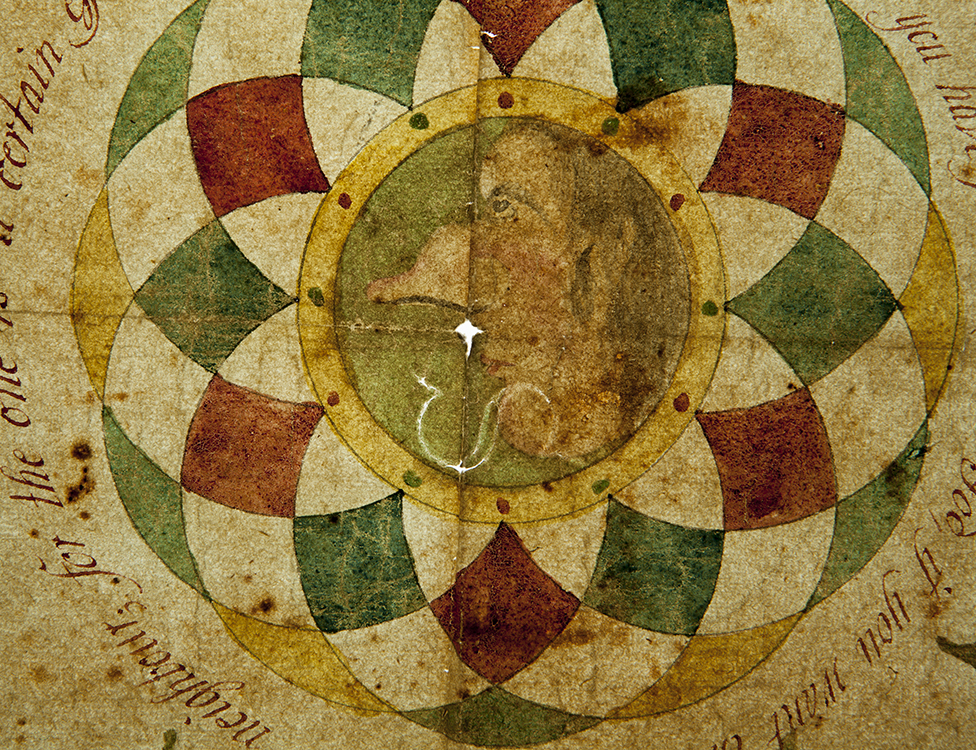
The inclusion of a likeness of the German puppet character Kasperle (Kasper) is unsual. The character would have been highly recognizeable in the early nineteenth century to people of German descent. The character often defeated evil (in the form of a witch, a devil, or a crocodile) with his slapstick and humor in early puppet shows.
See:
Bivins, John, Jr. “Fraktur in the South: An Itinerant Artist.” MESDA Journal vol. I, no. 2 (November 1975)
Conner, Juliana Margaret. Diary of Juliana Margaret Conner. Account of travels in western North Carolina and Tennessee, June 10 – October 17, 1827. Alexander Brevard Papers. Private Collections, North Carolina State Archives. P.C. 2.3.
Kolbe, Christian and Brent Holcomb, “Fraktur in the ‘Dutch Fork’ Area of South Carolina,” MESDA Journal vol. 5, no. 2: 36-51 (November 1979)
Magill, Courtney. “The Taufschein of Mary Margaret Hauseal: A Glimpse into German-American Life in the Dutch Fork, South Carolina. Journal of Backcountry Studies Vol, 8, No. 1 (Summer 2013)
Minardi, Lisa. Entry on “The Ehre Vater Artist”. The New Encyclopedia of Southern Culture Vol. 23: Folk Art. Carol Crown, Cheryl Rivers, Charles Reagan Wilson, editors.
Welshimer, Paula and John Bivins. Moravian Decorative Arts in North Carolina. Winston-Salem: Old Salem Inc. 1981, p.91
Related Objects: Acc#’s 209.2 Taufschein for Maria Hege; 2533 Taufschein for Sarah Zimmerman; 4646.1 Taufschein for Georg Hege; 5646 Taufschein for Maria Margaretha Hausihl
1790 – 1879+ — Salem, NC & Winston, NC
A paper mill or paper factory was constructed in the original Moravian settlement in North Carolina — Salem — in 1790 by Gottleib Shober. The Board of Overseers of the Moravian Church at Salem approved the venture on July 7, 1789. He had been the Salem store assistant, as well as a leather and tin craftsman.
To learn the art of paper making, Shober sent Christian Stauber to Ephrata, PA, to learn from Pennsylvania Dutch (German) paper makers. To construct the paper factory, Shober appealed in November 1789 for funding assistance from the North Carolina General Assembly, which was granted (£ 300). Construction of the mill pond and paper mill occurred during 1790. It was located on Peter’s Creek south of the main road leading west out of Salem (today, where Academy Street crosses Peter’s Creek).
By early 1791, the mill was producing paper; by July 1791 it was producing paper with watermarks of S or NC.
The paper mill was operated by Stauber, who became half-owner in Fall 1791. But the partnership lasted about a year.
By 1793, Shober was the sole owner. Around this time, Johann George was running the paper factory. George died in December 1800. His wife remarried in May 1801 to Joseph Gambold, who apparently took over running the paper mill.
In 1836, the paper mill was sold to John Christian Blum, who printed Blum’s Almanac and various newspapers in Salem, but Shober’s son, Emmanuel, resumed ownership and operated the factory until 1846. The factory was leased and operated from 1846 to 1863 by Francis Fries. In 1863, Robert Gray bought the factory and put in new machinery and steam power. In Branson’s Directory in 1872, it was reported that Gray’s paper mill was in Winston, NC. In 1873, the building was destroyed by fire.
In 1860, another paper mill — the Salem Paper Mill — was run by Rufus L. Patterson & Co., which he had started some time in the mid or late 1850s. His mill employed four workers in 1860 producing about $4,000 of paper each year. After the death of a partner, he sold the mill in October 1861, apparently buying it back. After the war, this mill was co-owned by Patterson and Henry W. Fries, along with their joint ownership of textile mills. This paper mill was still in operation in 1879 when Rufus Patterson died. (https://www.historync.org/NCpapermills.htm)
From the diary of a visitor to Salem, Julianna Conner, in June, 1827:Monday 23. As we could not visit the academy until 10 ok. We rode out to the paper mill a mile from town, where we were both pleased and astonished at the simple operation which produces so necessary an article the foreman a very intelligent black – showed us the different processes from the cutting of the rags – to the sheet which was ready for the sense or folly which may be inscribed on it.